
Apple Launches Siri AI With Next-Generation Apple Intelligence
Apple has released the next generation of Apple Intelligence, introducing Siri AI as a major redesign of its digital assistant alongside new AI-powered features across iPhone, iPad, Mac, Apple Watch and Apple Vision Pro.
Siri AI begins rolling out in beta in English with Apple’s 2027 software releases. Support for French, Japanese, Korean, Portuguese and Spanish is scheduled to follow next month. The new assistant combines conversational capabilities with personal context, onscreen awareness, web-based knowledge and deeper integration with apps.
The update is part of a broader expansion of Apple Intelligence that also brings new capabilities to Photos, Safari, Image Playground, Writing Tools, Shortcuts and other parts of Apple’s software ecosystem.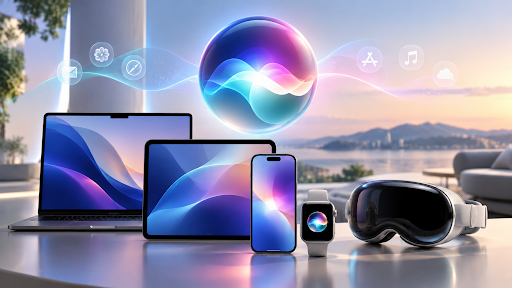
Siri AI Can Use Personal Context Across Apple Devices
One of the biggest changes is Siri AI’s ability to use information from a user’s personal context. The assistant can search across messages, emails, photos and other information to help answer requests or complete tasks.
Apple gives an example in which Siri can locate information about an upcoming family visit from Messages, find related cooking instructions in an email and then add ingredients to a grocery list in Reminders.
Siri AI also expands the range of actions that can be performed across apps. Apple says the assistant can handle tasks such as drafting emails, editing photos and sharing them. Existing integrations allow Siri to perform actions in third-party apps, while additional capabilities are planned for apps including Microsoft Outlook, Notability and Tripsy.
The assistant also introduces broader onscreen awareness. Users can ask questions about content currently displayed on their device and, where supported, take actions based on that information.
For example, Siri AI can identify upcoming home games while a user is viewing a sports website and add them to Calendar.
Siri AI Introduces Longer Conversations and a Dedicated App
The new Siri is designed to support follow-up questions, allowing a request to develop into a longer conversation rather than requiring users to start again with each prompt.
Apple is also expanding the ways users can access the assistant. On iPhone, Siri AI can be opened with the side button or by swiping down from the Dynamic Island. On iPad and Mac, it is integrated with Spotlight, while Mac users can also access Siri through systemwide context menus. Apple Vision Pro receives a spatial Siri AI interface.
A dedicated Siri app provides another major change. It allows users to start new conversations or return to previous ones. Conversation history can sync privately through iCloud across compatible Apple devices, including iPhone, Mac, iPad, Apple Watch and Apple Vision Pro.
Apple Improves Siri Voices and Systemwide Dictation
Siri AI also introduces more expressive voices and improved dictation on products that support Apple’s AFM Core Advanced on-device model.
Users can adjust the expressiveness and pace of Siri’s voice. Systemwide dictation is designed to turn speech into more polished text while automatically handling elements such as capitalization, punctuation and formatting.
Apple says the improvements are powered by its most advanced on-device model and are intended to improve speech understanding and transcription accuracy.
Visual Intelligence Expands to More Apple Devices
Visual Intelligence is expanding beyond iPhone to iPad, Mac and Apple Vision Pro, giving Siri AI additional multimodal capabilities.
On iPhone, Apple is integrating Siri directly into the Camera app through a new Siri mode. Users can point the camera at something and ask questions about what they see. Siri can also take related actions when appropriate.
Apple’s example involves viewing a music festival poster, asking about performance times and creating Calendar events based on the information.
The implementation varies by device:
- iPhone receives the new Siri mode in Camera
- iPad integrates Visual Intelligence into screenshots
- Mac provides a keyboard shortcut for selecting onscreen content and asking Siri about it
- Apple Vision Pro allows users to ask Siri about digital and physical objects they are looking at
These capabilities extend Siri’s visual understanding across Apple’s major computing platforms.
Siri AI Adds More Powerful Writing Tools
Apple is also integrating Siri AI more deeply into writing workflows.
Users can ask Siri to create a draft from scratch or modify existing text according to a description. In Mail and Messages, Siri can take into account how a user normally communicates with a particular recipient, including aspects of tone and punctuation.
Apple Intelligence also introduces automatic proofreading while users type across the system, including in most third-party apps.
Photos, Safari and Image Playground Receive New AI Features
The new generation of Apple Intelligence extends beyond Siri.
Photos receives several AI-powered editing capabilities. Spatial Reframing can adjust the perspective of an image after it has been captured, while Extend can expand the area around a subject. Apple has also improved Clean Up for removing unwanted distractions from photos.
Image Playground gains a new generative model running on Private Cloud Compute. It can generate images in different styles, including photorealistic imagery, and users can describe changes they want to make. Apple also plans support for the SynthID standard to help identify images generated or edited with Apple Intelligence tools.
Safari receives new AI-assisted browsing features. Tabs can be automatically grouped into topics, while Notify Me can alert users about changes to websites, including product restocks and price drops. Safari can also create custom extensions based on a user’s description.
Other Apple Intelligence updates include:
- Personalized Smart Reply in Mail and Messages
- Call Context in Phone
- Natural-language event creation and editing in Calendar
- The ability to create Shortcuts by describing an automation
- Enhanced video search and notification understanding in the Home app
The changes bring Apple Intelligence into a wider range of everyday tasks rather than limiting the technology to Siri alone.
Apple Watch Will Get Audio Intelligence Features
Additional Apple Intelligence capabilities are scheduled to arrive later this year for Apple Watch Series 12 and Apple Watch Ultra 4.
Apple calls this group of features Audio Intelligence. It includes Sound Recognition, Live Rewind, Siri Recap and Shazam integration.
Sound Recognition can identify important sounds such as sirens, alarms, doorbells or a baby crying and notify the wearer. Live Rewind can display the previous 15 seconds of a conversation as text after a double press of the Digital Crown.
Siri Recap can generate a high-level summary and key points from conversations, while Shazam can automatically identify nearby music and display the song and artist through the Smart Stack.
Apple says the Audio Intelligence system does not create or store audio recordings. Audio processing on supported watches uses the Secure Exclave in the S11 chip, with raw audio deleted after processing. Siri Recap and Live Rewind are scheduled to arrive in beta later this year.
Apple Intelligence Expands Into Health
Apple is also bringing additional AI capabilities to the Health app later this year.
A new Insights tab will use Apple Intelligence to highlight timely information from health data, including areas such as sleep and peak VO2 max. The system can also provide personalized guidance that adapts to the user’s data.
These health features are not part of the initial Siri AI rollout and are scheduled to become available later in the year.
Apple Uses On-Device Models and Private Cloud Compute
The new Apple Intelligence architecture combines on-device processing with Private Cloud Compute.
Apple says the next generation of Apple Foundation Models was developed in collaboration with Google and its Gemini models. Depending on the task, models can run directly on a device or use Apple’s Private Cloud Compute infrastructure.
For requests handled through Private Cloud Compute, Apple states that personal data is not stored or made accessible to Apple. Siri AI also uses on-device technologies such as the Spotlight index and App Toolbox for certain actions.
Which Devices Support Apple Intelligence and Siri AI?
Apple Intelligence with the 2027 operating system releases supports a range of recent Apple devices, including:
- iPhone 16 models or later
- iPhone 15 Pro and iPhone 15 Pro Max
- iPad mini with A17 Pro
- iPad models with M1 or later
- MacBook Neo with A18 Pro
- Mac models with M1 or later
- Apple Vision Pro
- Apple Watch Series 9 or later
- Apple Watch Ultra 2 or later
- Apple Watch SE 3 when paired with a nearby Apple Intelligence-enabled iPhone
Apple Intelligence supports a wider range of languages, although language availability varies by feature and device.
Siri AI will not initially be available on iOS, iPadOS and watchOS in the European Union. Apple also says Siri AI and the other new Apple Intelligence features will not be available in China while the company works through regulatory requirements.
Some server-based Apple Intelligence capabilities will also be subject to daily usage limits. Apple says expanded access to certain features will be offered for a fee in the future.
Apple Gift Cards Can Be Used for Apps and Digital Services
The arrival of Siri AI is part of a wider expansion of Apple’s software ecosystem, but many everyday purchases across that ecosystem continue to use an Apple Account balance.
App Store and iTunes gift cards available through Baxity Store can be redeemed for eligible digital purchases such as apps, games, subscriptions including Apple Music, and iCloud services.
Baxity Store lists Apple gift cards for multiple countries and currencies, with available denominations depending on the selected region. Users should choose a card that is compatible with the country or region of the Apple account where it will be redeemed.