Aptos is a Layer 1 blockchain built to provide high performance infrastructure for decentralized applications, digital assets, and Web3 services. Developed by Aptos Labs and launched in 2022, the network attracted significant attention because it was created by former Meta engineers who previously worked on the Libra and Diem blockchain initiatives. By combining an advanced execution engine, the Move programming language, and a Proof of Stake consensus mechanism, Aptos aims to solve many of the scalability and efficiency challenges faced by earlier blockchain platforms.
The native cryptocurrency of the network is APT. It is used to pay transaction fees, participate in staking, reward validators, support decentralized governance, and power applications built on the blockchain. Today, Aptos is considered one of the leading next generation Layer 1 networks and competes with platforms such as Solana, Avalanche, Sui, and Near Protocol. This article explains how Aptos works, how the project was created, what makes its technology different, and how APT is used throughout the ecosystem.
Using Cryptocurrency for Digital Purchases at Baxity Store
Cryptocurrencies are increasingly being used for more than investing, trading, or transferring digital assets. Today, many users prefer to spend cryptocurrency on products and services they can access immediately, making digital assets a practical payment method for everyday online purchases. Instead of navigating complex decentralized applications or converting cryptocurrency into traditional currency first, users can purchase digital products that are delivered instantly after payment.
Baxity Store is a digital marketplace designed to simplify this experience. The platform allows customers to purchase a wide selection of digital products, including gift cards, prepaid payment solutions, gaming credits, and other digital services using supported cryptocurrency payment methods. Digital codes are delivered shortly after a successful transaction, allowing users to redeem them for subscriptions, entertainment, online shopping, and many other digital purchases.
In addition to gift cards and gaming products, Baxity Store offers various crypto related vouchers and prepaid cards connected to popular payment platforms and digital ecosystems. These products provide a convenient way to transform cryptocurrency into practical purchasing power for everyday online spending. By combining secure cryptocurrency payments with fast digital delivery, Baxity Store helps make digital assets easier to use in real world digital commerce.
What Is Aptos (APT)?
Aptos is an open source Layer 1 blockchain designed to deliver secure, scalable, and efficient infrastructure for decentralized applications. Unlike many traditional blockchains that execute transactions one after another, Aptos can process multiple independent transactions simultaneously. This significantly increases network performance while maintaining the accuracy and security expected from a public blockchain.
The project was developed by Aptos Labs, a blockchain company founded by Mo Shaikh and Avery Ching, both former members of Meta’s blockchain division. Much of the research behind Aptos originated from the Libra and Diem projects, which introduced several technical innovations before being discontinued due to regulatory challenges. Aptos takes many of those ideas further while operating as an independent decentralized blockchain.
The network supports smart contracts, digital asset management, decentralized finance, NFTs, blockchain gaming, and many other Web3 applications. Its native cryptocurrency, APT, serves as the economic foundation of the ecosystem by enabling transactions, securing the network, and supporting governance.
Today, Aptos is used for a wide variety of blockchain applications, including:
- Decentralized finance (DeFi)
- NFT marketplaces
- Blockchain gaming
- Web3 social platforms
- Stablecoin infrastructure
- Tokenization of real world assets
- Enterprise blockchain solutions
The long term objective of Aptos is to provide infrastructure capable of supporting millions of users without sacrificing transaction speed, security, or decentralization.
The History of Aptos
The origins of Aptos date back to 2019, when Meta announced the Libra project. The goal was to create a global blockchain based payment network supported by a digital currency that could make international payments faster and more accessible. Although Libra generated enormous interest, it also faced intense regulatory scrutiny from governments and financial authorities around the world.
In an effort to address these concerns, Libra was later renamed Diem. Despite multiple revisions, the project was eventually discontinued before its public launch. However, the technology developed during the initiative was far from abandoned.
Recognizing the potential of the underlying architecture, former Meta engineers Mo Shaikh and Avery Ching established Aptos Labs in 2021. Their objective was to continue developing the technology as an independent public blockchain focused on scalability, security, and developer accessibility.
Following extensive testing, the Aptos mainnet officially launched in October 2022. The project quickly attracted considerable attention from both developers and investors, securing funding from several well known venture capital firms and accelerating ecosystem growth.
The evolution of Aptos can be summarized through several key milestones.
| Year | Milestone |
|---|---|
| 2019 | Meta introduces the Libra blockchain project. |
| 2020 | Libra is rebranded as Diem. |
| 2021 | Aptos Labs is founded by Mo Shaikh and Avery Ching. |
| 2022 | Aptos mainnet launches together with the APT token. |
| 2023 onward | The ecosystem expands across DeFi, NFTs, gaming, wallets, and developer infrastructure. |
Since launch, hundreds of developers have begun building applications on Aptos, while the ecosystem continues to grow through new protocols, infrastructure providers, wallet integrations, and strategic partnerships.
How Does Aptos Work?
Aptos was designed to improve blockchain performance without compromising security or decentralization. Rather than relying on a traditional architecture where transactions are processed sequentially, the network introduces several innovations that enable much higher throughput and lower latency.
At the core of Aptos is a Proof of Stake consensus mechanism. Validators stake APT tokens to participate in securing the blockchain and validating transactions. In return, they receive staking rewards for honest participation, while malicious behavior may result in penalties. This economic model helps maintain network integrity while encouraging long term participation.
One of the blockchain’s most important innovations is Block-STM, a parallel transaction execution engine. Traditional blockchains process transactions individually, requiring each transaction to wait until the previous one has finished. Aptos instead analyzes transaction dependencies and executes independent transactions simultaneously before verifying the final state. This approach allows the network to utilize modern multi core hardware far more efficiently.
Another key component is AptosBFT, the blockchain’s Byzantine Fault Tolerant consensus protocol. It enables validators to reach agreement quickly while maintaining security even if some participants behave incorrectly or go offline. Combined with optimized networking, storage, and state synchronization, Aptos can achieve very fast transaction confirmation times.
The network architecture consists of several major components:
- Proof of Stake consensus
- Block-STM parallel transaction execution
- AptosBFT consensus protocol
- Move Virtual Machine for smart contract execution
- Distributed validator network
- On chain governance
- Modular infrastructure that supports continuous protocol upgrades
Together, these technologies allow Aptos to deliver high throughput while remaining flexible enough to support future improvements as blockchain technology evolves.
What Makes Aptos Different from Other Blockchains?
The blockchain industry includes dozens of Layer 1 networks that aim to improve scalability and reduce transaction costs. Aptos distinguishes itself through several architectural innovations that work together to maximize performance while preserving security and decentralization.
Perhaps the most significant difference is parallel transaction execution. Many blockchains still execute every transaction sequentially, creating bottlenecks as network activity increases. Aptos can identify transactions that do not interfere with one another and process them simultaneously, resulting in much greater efficiency under heavy workloads.
The blockchain also features a modular architecture. Individual components responsible for execution, consensus, storage, and networking can be upgraded independently, allowing developers to improve the protocol without requiring disruptive hard forks.
Another important advantage is the Move programming language. Unlike general purpose programming languages that were later adapted for blockchain development, Move was created specifically to manage digital assets securely. Its resource oriented design reduces the likelihood of several common smart contract vulnerabilities.
Compared with many competing Layer 1 blockchains, Aptos focuses on delivering:
- High transaction throughput
- Low latency and fast transaction finality
- Low transaction costs
- Strong smart contract security through Move
- Efficient use of modern hardware
- Flexible protocol upgrades
- Infrastructure capable of supporting large scale decentralized applications
These characteristics position Aptos as a blockchain intended not only for cryptocurrency transactions but also for enterprise systems, financial applications, gaming platforms, digital identity solutions, and other high demand Web3 services.
The Move Programming Language
One of Aptos’ defining technologies is the Move programming language. Originally developed during the Diem project, Move was designed specifically for blockchain applications instead of adapting an existing programming language to work with digital assets.
Move introduces a resource oriented programming model in which digital assets are treated as unique resources. Unlike ordinary data that can be copied or accidentally deleted, resources in Move can only be transferred according to strict rules defined within the smart contract. This significantly reduces the risk of programming errors that could otherwise result in lost or duplicated assets.
Security was one of the primary design goals of Move. The language supports formal verification techniques that allow developers to mathematically verify certain properties of smart contracts before deployment. This is particularly valuable for decentralized finance applications, where software bugs can have significant financial consequences.
Move also promotes modular development by allowing developers to build reusable software components that simplify application development while maintaining consistent security standards. As the Aptos ecosystem expands and additional blockchain projects adopt Move based architectures, the language continues to gain recognition as one of the leading smart contract languages in the blockchain industry.
What Is APT Used For?
APT is the native cryptocurrency of the Aptos blockchain and plays a central role in the operation of the entire network. Rather than serving only as a tradable digital asset, APT provides the economic incentives that keep the blockchain secure while enabling users and developers to interact with decentralized applications.
Every transaction performed on the Aptos blockchain requires a small fee paid in APT. These fees compensate validators for processing transactions while also helping protect the network from spam and malicious activity. Because Aptos was designed for high throughput, transaction fees generally remain relatively low compared to many older blockchain networks.
APT also enables token holders to participate in staking. By locking their tokens with validators, users contribute to network security and may receive staking rewards based on validator performance and the overall staking conditions. This mechanism aligns the interests of validators and token holders while supporting decentralization.
The primary uses of APT include:
- Paying transaction fees
- Participating in staking
- Securing the blockchain through validator operations
- Receiving staking rewards
- Voting on governance proposals
- Supporting decentralized applications and smart contracts
- Providing liquidity within the Aptos ecosystem
As the ecosystem expands, demand for APT is influenced not only by investor interest but also by the growing number of applications and services operating on the blockchain.
Aptos Tokenomics
APT was introduced alongside the launch of the Aptos mainnet in October 2022. The network initially created a supply of 1 billion APT tokens, which were allocated across several categories to support long term ecosystem growth and network development.
The initial allocation included funding for the Aptos Foundation, Aptos Labs, community initiatives, ecosystem grants, and early investors. Rather than releasing all tokens immediately, much of the supply follows predetermined vesting schedules that gradually unlock tokens over several years. This approach is intended to reduce sudden increases in circulating supply while supporting sustainable development.
Like many Proof of Stake networks, Aptos also introduces new tokens through staking rewards. Validators and delegators receive additional APT for participating in network security. At the same time, transaction fees paid by users are burned, permanently removing a portion of tokens from circulation. The interaction between staking rewards and fee burning influences the long term supply dynamics of the network.
Several factors can affect the value and circulation of APT over time, including ecosystem growth, user activity, staking participation, token unlock schedules, and overall cryptocurrency market conditions.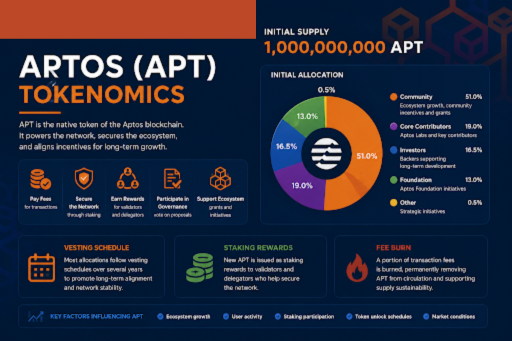
What Can Aptos Be Used For?
Aptos was designed as a general purpose blockchain capable of supporting a broad range of decentralized applications. Its combination of high throughput, low latency, and secure smart contracts makes it suitable for both consumer and enterprise use cases.
Decentralized finance remains one of the largest sectors within the Aptos ecosystem. Developers have created decentralized exchanges, lending protocols, liquidity platforms, stablecoin services, and yield generating applications that allow users to access financial services without relying on traditional intermediaries.
NFTs also represent an important area of development. Aptos supports digital collectibles, gaming assets, ticketing systems, membership credentials, and tokenized intellectual property. The blockchain’s efficient architecture allows NFT marketplaces to process transactions quickly while keeping costs relatively low.
Gaming has become another major focus. Blockchain games often require thousands of in game transactions involving digital assets, making performance especially important. Aptos was designed with this type of workload in mind, allowing developers to build games that deliver a smoother user experience.
Additional use cases continue to emerge across areas such as decentralized identity, tokenized real world assets, supply chain management, digital payments, and enterprise infrastructure.
Aptos Ecosystem
Since its launch, Aptos has developed into a rapidly expanding blockchain ecosystem supported by developers, infrastructure providers, exchanges, and technology partners. Hundreds of projects have been built or are actively being developed across multiple sectors of Web3.
The ecosystem includes decentralized exchanges that facilitate token trading, lending protocols that provide decentralized borrowing and lending services, wallet providers that simplify asset management, NFT marketplaces, blockchain games, developer tools, cross chain bridges, analytics platforms, and decentralized identity solutions.
Several major stablecoins and blockchain infrastructure companies have also integrated with Aptos, helping improve liquidity and making it easier for developers and users to access the network. Continued ecosystem growth remains one of the most important factors supporting long term adoption of the blockchain.
Aptos vs Solana vs Sui
Aptos is frequently compared with other high performance Layer 1 blockchains, particularly Solana and Sui. While all three networks aim to provide fast and scalable infrastructure, they differ in architecture, development approach, and ecosystem maturity.
Solana has one of the largest existing ecosystems and a long history of supporting decentralized finance and consumer applications. Aptos focuses on combining parallel transaction execution with the Move programming language to improve security and scalability. Sui, another blockchain developed using Move based technology, also emphasizes object oriented asset management but follows a different execution model.
Although technical comparisons often focus on theoretical transaction throughput, actual network performance depends on validator participation, application design, and real world demand. Each platform continues to evolve as new upgrades and developer tools are introduced.
Is Aptos Secure?
Security has been a core design principle of Aptos from the beginning. Rather than relying solely on traditional blockchain security mechanisms, the project combines multiple technologies that work together to protect both the network and user assets.
The Proof of Stake consensus mechanism incentivizes validators to behave honestly through staking rewards while discouraging malicious activity through economic penalties. Because validators must commit their own APT tokens, they have a direct financial incentive to maintain network integrity.
The Move programming language also contributes significantly to security. Its resource oriented design helps prevent common smart contract vulnerabilities associated with accidental asset duplication, unauthorized transfers, or programming mistakes. In addition, Move supports formal verification techniques that allow developers to mathematically verify certain contract properties before deployment.
Regular code reviews, ongoing protocol improvements, and an active developer community further strengthen the overall resilience of the Aptos ecosystem.
Advantages and Disadvantages of Aptos
Like every blockchain platform, Aptos has both strengths and limitations. Its modern architecture and advanced technology make it an attractive option for developers building decentralized applications, but the project also faces challenges that are common for newer blockchain ecosystems.
| Category | Advantages | Challenges |
|---|---|---|
| Performance | High transaction throughput through parallel execution. | Competition from well established Layer 1 blockchains with larger user communities. |
| Cost and Speed | Low transaction latency and relatively low network fees. | A younger ecosystem with fewer mature decentralized applications than some competitors. |
| Security | The Move programming language, designed with digital asset security in mind. | Continued dependence on developer adoption to expand available services. |
| Architecture | A modular architecture that supports future protocol upgrades. | Market volatility that can influence ecosystem growth and user activity. |
| Ecosystem | An expanding ecosystem backed by active developer participation and significant investment. | Success depends on continued growth relative to competing networks. |
As the blockchain industry continues to evolve, the long term success of Aptos will largely depend on its ability to attract developers, support innovative applications, and maintain steady ecosystem growth while competing with other leading blockchain networks.
How to Buy and Store APT
APT is available through many centralized cryptocurrency exchanges where users can purchase the token using fiat currencies or other cryptocurrencies. After purchasing APT, users may keep their assets on an exchange or transfer them to a self custodial wallet for greater control over their funds.
Several software wallets support the Aptos blockchain, allowing users to store tokens, interact with decentralized applications, participate in staking, and manage digital assets. Hardware wallets that support Aptos provide an additional layer of security by storing private keys offline.
Regardless of the storage method, users should protect their recovery phrases, enable two factor authentication whenever available, and carefully verify wallet addresses before sending transactions.
Conclusion
Aptos is one of the newest generation of Layer 1 blockchains, combining high performance infrastructure with modern blockchain architecture. Built by former Meta engineers, the network introduces innovations such as parallel transaction execution, the Move programming language, and a scalable Proof of Stake consensus mechanism to support decentralized applications at scale.
The APT cryptocurrency serves as the foundation of the ecosystem by powering transactions, staking, governance, and network security. As Aptos continues to attract developers and expand its ecosystem, the blockchain is positioning itself as a platform capable of supporting financial services, gaming, digital assets, enterprise applications, and many other Web3 use cases.
Beyond blockchain applications, cryptocurrencies such as APT are also becoming practical tools for everyday online spending. Platforms like Baxity Store allow users to purchase gift cards, gaming products, prepaid payment solutions, and other digital goods using supported cryptocurrencies, helping bridge the gap between blockchain technology and real world digital commerce.
Frequently Asked Questions About Aptos (APT)
Can Aptos support enterprise applications?
Yes, Aptos was designed with enterprise adoption in mind. Its architecture focuses on predictable performance, high throughput, and the ability to handle large numbers of users simultaneously, which are important requirements for business applications. Organizations can use the network to manage digital assets, automate workflows through smart contracts, and build secure customer facing services. The blockchain’s modular design also allows upgrades to be introduced without causing major disruptions to network operations. While enterprise adoption is still developing, Aptos provides many of the technical capabilities businesses typically look for when evaluating blockchain infrastructure.
Why do developers choose Aptos over other Layer 1 blockchains?
Developers are often attracted to Aptos because of its modern architecture and emphasis on security. The Move programming language was specifically created to reduce common smart contract vulnerabilities, making it easier to build applications that manage digital assets safely. Parallel transaction execution also enables developers to design applications that can scale more efficiently as user activity increases. In addition, Aptos provides extensive developer documentation, software development kits, testing tools, and community resources that simplify application development. Although other Layer 1 networks offer similar capabilities, Aptos combines several technologies that appeal to teams building high performance decentralized applications.
What factors influence the price of APT?
Like most cryptocurrencies, the price of APT is determined by supply and demand in the market. Adoption of the Aptos ecosystem, the launch of new decentralized applications, network activity, and staking participation can all influence investor interest. Broader cryptocurrency market trends also play a significant role, since many digital assets tend to move alongside overall market sentiment. Token unlock schedules may affect circulating supply, while positive technical developments or major partnerships can improve confidence in the project. As with any cryptocurrency, price movements remain volatile and should not be viewed as guaranteed indicators of future performance.
Can Aptos interact with other blockchain networks?
Although Aptos operates as an independent Layer 1 blockchain, it is increasingly connected to the broader blockchain ecosystem through cross chain infrastructure. Various bridge protocols enable users to transfer selected digital assets between Aptos and other supported blockchains. Developers are also creating interoperability solutions that allow decentralized applications to exchange data and assets across multiple networks. This growing connectivity makes it easier for users to access liquidity and services without remaining within a single blockchain ecosystem. As interoperability technologies continue to mature, cross chain functionality is expected to become even more important for Aptos.
What should users consider before staking APT?
Staking can provide rewards, but users should understand how the process works before committing their tokens. Different validators may offer varying levels of reliability, commission rates, and historical performance, making validator selection an important decision. Some staking arrangements may include waiting periods before tokens can be withdrawn, which could reduce short term liquidity. Users should also remember that staking rewards are not fixed and may change as network conditions evolve. Reviewing the validator’s reputation, security practices, and operational history can help reduce potential risks while supporting the long term stability of the network.
What is the future outlook for Aptos?
The long term success of Aptos will depend on continued ecosystem growth, developer adoption, and the ability to attract real world applications. Competition among Layer 1 blockchains remains intense, with many projects pursuing similar goals of scalability and decentralization. However, Aptos continues to expand its ecosystem through new decentralized finance platforms, gaming projects, infrastructure providers, and enterprise initiatives. Ongoing protocol upgrades and improvements to developer tools may further strengthen its position within the blockchain industry. While no blockchain can guarantee long term success, Aptos has established a strong technical foundation that gives it the potential to remain an important participant in the evolving Web3 ecosystem.