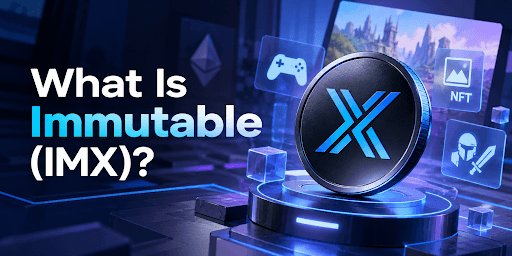
Blockchain technology makes it possible to own and transfer digital assets, but traditional blockchains are not always convenient for games that may require frequent and inexpensive transactions. Immutable is a Web3 ecosystem focused primarily on blockchain gaming and digital ownership. It provides infrastructure that helps developers integrate blockchain features while remaining connected to the Ethereum ecosystem.
IMX is the utility token associated with Immutable. It is used for several functions within the ecosystem, including network fees, staking, and governance. However, Immutable and IMX are not the same thing. Immutable is the broader platform and technology ecosystem, while IMX is the cryptocurrency that supports its economic infrastructure.
Using Cryptocurrency for Digital Purchases at Baxity Store
Baxity Store provides a practical way to connect cryptocurrency with everyday digital purchases. Rather than using crypto only for trading or holding, customers can purchase digital products such as gift cards, prepaid cards, gaming credits, and vouchers for various online services. This creates a familiar shopping experience while giving users access to cryptocurrency payment options available at checkout.
The store also offers digital products associated with popular gaming, entertainment, shopping, and payment platforms. Depending on the selected product, these cards and vouchers can be used for online purchases, subscriptions, account balances, games, or other digital services. Available cryptocurrency payment methods may vary, so customers should check the options displayed during checkout before completing an order.
With digital code delivery and a broad selection of products, Baxity Store helps connect the crypto economy with practical online spending. Users can choose a suitable card or voucher, select one of the currently supported payment methods, and receive a digital product without having to navigate complex blockchain services.
What Is Immutable Crypto (IMX)?
Immutable is a blockchain infrastructure platform developed primarily for Web3 games and digital assets. The project began with a strong focus on NFT scalability through Immutable X and later expanded into a broader ecosystem that includes Immutable zkEVM, Passport, developer tools, marketplace infrastructure, and other products.
The IMX token is an important part of this ecosystem. IMX is an ERC-20 utility token with a maximum supply of 2 billion tokens. Within the Immutable ecosystem, its main functions include:
- Supporting transaction and network fees
- Participating in IMX staking
- Taking part in governance
- Supporting economic activity and incentives across the ecosystem
This distinction is important when discussing what IMX crypto is. IMX is not an individual game currency and Immutable is not simply another name for the token. Games built using Immutable infrastructure can have their own currencies, NFTs, and economic models alongside IMX.
Immutable was founded in Australia and initially became widely known through Immutable X, its Ethereum scaling solution focused on NFTs. The ecosystem has since expanded considerably, particularly through infrastructure designed specifically for Web3 game developers.
How Does Immutable Blockchain Work?
The Immutable blockchain ecosystem addresses one of the practical problems of using Ethereum for gaming: processing large numbers of transactions directly on Ethereum mainnet can be expensive and inefficient for applications where users frequently interact with digital assets.
Instead of requiring every supported action to be processed individually on Ethereum Layer 1, Immutable uses scaling technology that can handle activity through additional infrastructure while maintaining a connection to Ethereum. This is particularly useful for games, where players may regularly mint, acquire, transfer, or trade blockchain-based items.
One of the technologies associated with Immutable is the ZK-rollup model. In simplified terms, multiple transactions can be processed together rather than individually on Ethereum. Cryptographic proofs can then be used to verify the resulting state. This approach reduces the amount of information that Ethereum needs to process directly while preserving blockchain verification.
A simplified transaction flow looks like this:
- Users submit transactions through the supported Immutable environment.
- Multiple transactions can be processed outside Ethereum mainnet.
- The system groups and processes the relevant transaction data.
- A cryptographic proof or settlement data is submitted to the underlying blockchain.
- Ethereum provides the settlement or security layer required by the specific solution.
The exact process depends on which Immutable technology is being used. This is why Immutable X and Immutable zkEVM should not be treated as two names for the same network.
Immutable X vs Immutable zkEVM
Immutable X and Immutable zkEVM are both part of the Immutable ecosystem, but they were designed for different purposes. Immutable X uses StarkEx-based technology and focuses heavily on NFT and digital asset transactions. Immutable zkEVM provides a programmable, EVM-compatible environment designed for blockchain games and applications that require smart contracts.
| Feature | Immutable X | Immutable zkEVM |
|---|---|---|
| Main focus | NFTs and digital assets | Web3 games and applications |
| Smart contracts | No general-purpose deployment | Supported |
| EVM compatibility | No | Yes |
| Developer model | Predefined functionality and APIs | Programmable smart contracts |
| IMX role | Ecosystem utility token | Native token |
This difference gives developers different options. Immutable X is suitable for applications that need specialized NFT functionality without unrestricted smart contracts, while Immutable zkEVM provides greater flexibility for developers building complex game economies and blockchain applications.
The distinction is also important for users. Assets do not necessarily exist identically across both environments, and transferring them between networks may require supported bridging or migration mechanisms.
What Is IMX Crypto Used For?
IMX crypto has several functions within the Immutable ecosystem rather than serving only as an asset that can be bought, sold, or transferred. Its utility is connected to network activity, staking, governance, and the broader economic model surrounding Immutable.
The main IMX use cases include:
- Transaction fees. IMX plays a role in fees within the ecosystem. Fee mechanics depend on the specific Immutable environment, so users should not assume that every transaction is either free or always paid in the same way.
- IMX staking. Eligible token holders can participate in staking and potentially receive rewards according to the current staking conditions. Reward rates and eligibility requirements can change over time.
- Governance. IMX holders can participate in eligible governance processes and vote on proposals covered by the governance framework.
- Ecosystem utility. IMX provides a common economic asset within the broader Immutable ecosystem, while individual games can still issue and manage their own tokens.
On Immutable zkEVM, IMX functions as the native token and is directly connected to network transactions. Immutable X uses a different architecture and fee model, another reason why the two technologies should be distinguished when explaining IMX token utility.
How Immutable Gaming and NFTs Work
Gaming is the primary focus of the Immutable ecosystem. Developers can use Immutable infrastructure to introduce blockchain-based ownership without moving every element of a game onto a blockchain. Traditional game systems can continue handling gameplay, while selected assets or economic functions use blockchain infrastructure.
Immutable gaming can support several types of digital assets and activities:
- Characters, skins, weapons, cards, and collectibles represented as NFTs
- Ownership and transfer of blockchain-based in-game assets
- Buying and selling supported assets through NFT marketplaces
- Game-specific fungible tokens and digital currencies
- Rewards distributed through selected games or events
- Blockchain-based marketplaces and game economies
One of the main concepts behind this model is digital ownership. In a conventional game, an item usually exists inside the publisher's database and remains tied to that game's account system. When an item is represented as an NFT, ownership can instead be associated with a blockchain wallet. Depending on the rules of the game, this can allow the asset to be transferred or traded.
Not every in-game item needs to be placed on-chain. Developers may keep frequently used resources, experience points, basic currencies, or other gameplay data off-chain while using NFTs for assets where verifiable ownership and transferability provide a practical benefit.
Play-to-earn mechanics can also be implemented in games using Immutable infrastructure, but Immutable gaming itself is not synonymous with play-to-earn. Individual developers determine whether players can receive tokens, NFTs, or other rewards for achievements, tournaments, quests, or participation.
NFT marketplaces provide another layer of the ecosystem by allowing supported assets to be listed and traded. However, blockchain ownership and marketplace availability do not guarantee that an item will retain its value. The demand for a gaming NFT can depend on the popularity of the game, the size of its player base, scarcity, utility, market conditions, and continued developer support.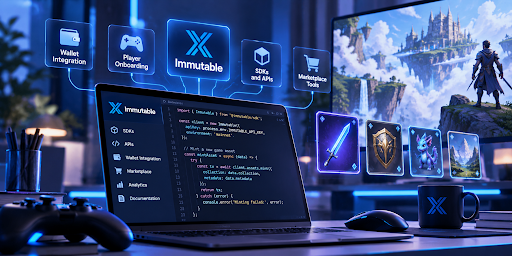
Immutable Gaming Platform for Developers
Immutable is not limited to blockchain transaction processing. The Immutable gaming platform also provides tools intended to help developers add Web3 functionality without building wallets, authentication systems, marketplaces, and blockchain integrations entirely from scratch.
One example is Immutable Passport, a non-custodial wallet and authentication solution designed for games. It allows players to access supported Web3 functionality through a more familiar onboarding process. For developers, the broader Immutable ecosystem also includes SDKs, APIs, commerce infrastructure, and tools for managing blockchain assets.
This developer-focused approach is important because blockchain gaming involves more than creating a token or NFT collection. A game may need to handle player onboarding, wallets, asset ownership, transactions, marketplaces, and interactions between blockchain and conventional game systems. Immutable provides infrastructure for these functions while allowing studios to determine which elements of their games should operate on-chain.
Immutable vs Ethereum: What Is the Difference?
Immutable and Ethereum perform different roles and should not be viewed simply as competing cryptocurrencies. Ethereum is a general-purpose blockchain platform that supports smart contracts and decentralized applications across many industries. The Immutable ecosystem is focused more specifically on Web3 gaming and digital assets and uses technology connected to Ethereum.
The main differences can be summarized as follows:
- Purpose: Ethereum supports a broad range of decentralized applications, while Immutable specializes primarily in gaming and digital ownership.
- Scaling: Immutable solutions are designed to reduce the need to execute every supported gaming transaction directly on Ethereum mainnet.
- Gaming infrastructure: Immutable provides specialized products for developers, players, wallets, digital assets, and game economies.
- Tokens: ETH is Ethereum's native cryptocurrency, while IMX serves as the utility token of the Immutable ecosystem and the native token on Immutable zkEVM.
- Smart contracts: Ethereum supports general-purpose smart contracts, while capabilities within Immutable depend on whether a project uses Immutable X or Immutable zkEVM.
For this reason, the comparison of Immutable vs Ethereum is not simply a choice between two networks. Immutable uses Ethereum-related infrastructure while adding scaling and gaming-specific tools intended to make blockchain technology more practical for games.
Immutable Use Cases in Web3 Gaming
Immutable use cases are largely connected with games that need verifiable digital ownership, blockchain transactions, or transferable assets. Developers can decide how extensively these features are integrated, so two games built using Immutable technology may have very different blockchain economies.
Common applications include trading card games where cards exist as NFTs, RPGs with blockchain-based characters or equipment, collectible assets, game-specific tokens, and marketplaces for player-owned items. Immutable can also support reward systems and other game economies in which blockchain assets are distributed or exchanged.
Games such as Gods Unchained and Guild of Guardians have helped demonstrate how Immutable technology can be applied to gaming. However, games built on Immutable do not have to follow a single economic model. Some may make extensive use of NFTs and tokens, while others can use blockchain only for selected assets or ownership functions.
Immutable Crypto Development and Key Milestones
Immutable has evolved from a project strongly associated with NFT scaling into a broader Web3 gaming ecosystem. Immutable X established the project's early focus on scalable NFT transactions, while later development expanded the available infrastructure for games and developers.
One of the most significant developments was Immutable zkEVM, which added an EVM-compatible environment with programmable smart contracts. The ecosystem has also expanded through products such as Immutable Passport and developer tools designed to simplify player onboarding and blockchain integration. Together, these developments show how Immutable crypto infrastructure has moved beyond NFT transactions toward a more complete technology stack for Web3 games.
This development also explains why older descriptions of Immutable may differ from current ones. Information that refers only to Immutable X does not necessarily describe the entire Immutable ecosystem today.
Advantages and Risks of Immutable Crypto
Immutable crypto infrastructure is designed around a specific market rather than trying to serve every possible blockchain application. Its focus on gaming can be an advantage for developers who need specialized tools for digital assets, wallets, marketplaces, and player onboarding. Ethereum compatibility within parts of the ecosystem also gives developers access to established Web3 standards and tools.
At the same time, both the technology and IMX crypto involve risks and limitations. Important factors to consider include:
- IMX price volatility and broader cryptocurrency market conditions
- Dependence on continued adoption of Web3 and blockchain gaming
- Competition from other gaming networks and scaling solutions
- Technical risks involving smart contracts, wallets, bridges, and blockchain applications
- Changes to staking, fees, incentives, or other ecosystem mechanisms
- Regulatory uncertainty surrounding cryptocurrencies and digital assets
The success of individual games is another important factor. Building on Immutable does not guarantee that a game will attract players or that its NFTs and tokens will maintain demand. Technical infrastructure can support a game economy, but it cannot determine the commercial success or market value of its assets.
How to Buy and Store IMX Crypto
Users who want to buy IMX crypto can typically obtain the token through cryptocurrency platforms that support it. Available exchanges, payment methods, fees, and verification requirements vary by country and platform, so these conditions should be checked before making a transaction.
The basic process usually involves choosing a platform that lists IMX, creating an account if required, adding funds or another supported cryptocurrency, selecting IMX, and reviewing the transaction before confirming the purchase. Users should pay particular attention to the selected network, withdrawal fees, and wallet compatibility if they intend to transfer the tokens afterward.
IMX can be kept with a custodial service or transferred to a compatible non-custodial wallet. A custodial platform manages the private keys on behalf of the user, while a non-custodial IMX wallet gives the user direct responsibility for controlling the keys and securing access. Hardware wallets may also be suitable when they support the required token and network.
Before transferring IMX, users should always verify the destination address and supported network. Sending crypto assets through an incompatible network or to an unsupported address can result in the permanent loss of funds.
Is IMX a Gaming Coin and What Determines Its Value?
IMX is commonly associated with the gaming category because the Immutable ecosystem is built primarily around Web3 games and digital assets. However, describing IMX simply as a gaming coin does not explain its full role. The IMX token also has utility connected with network fees, staking, governance, and other economic functions within the Immutable ecosystem.
Like other cryptocurrencies, the market value of IMX can be influenced by several factors. These include adoption of Immutable technology, activity across games and blockchain applications, demand for the token's utility, token supply, staking participation, development of the wider ecosystem, competition, and general cryptocurrency market conditions.
The relationship between ecosystem growth and token price is not automatic. A growing number of games or users does not guarantee that IMX will increase in value, just as a decline in its market price does not necessarily mean that development of the Immutable network has stopped. IMX remains a volatile crypto asset, so its technology, token utility, tokenomics, and market risks should be considered separately when evaluating the project.
Frequently Asked Questions About Immutable (IMX) Crypto
Does IMX Have a Maximum Supply? Yes, IMX has a maximum token supply of 2 billion tokens. However, maximum supply should not be confused with circulating supply, which represents the tokens currently available on the market and can change over time. Some tokens may be allocated to ecosystem development, rewards, project funding, or other purposes according to the token distribution model. Changes in circulating supply can be relevant to users analyzing IMX tokenomics because new tokens entering circulation may affect market dynamics. For the latest figures, users should check current blockchain data and official Immutable resources rather than relying on older articles or historical statistics.
Is Immutable X the Same as Immutable? No, Immutable X is one part of the broader Immutable ecosystem rather than another name for the entire project. This distinction has become more important as Immutable has introduced additional products and blockchain infrastructure. For example, the ecosystem now includes Immutable zkEVM, Passport, developer tools, and other services alongside Immutable X. Older articles may use "Immutable" and "Immutable X" almost interchangeably because Immutable X was previously the project's most recognizable blockchain product. When researching the platform today, users should check whether information refers specifically to Immutable X or to the wider Immutable ecosystem.
What Wallets Can Be Used With IMX? Wallet compatibility depends on the network and Immutable product a user intends to access. Because IMX exists within the Ethereum ecosystem and is also used across Immutable infrastructure, users should verify that a wallet supports the relevant token and network before transferring funds. Immutable Passport provides a wallet and identity solution designed specifically to simplify access to supported games and applications. Other compatible self-custody wallets may also be used depending on the application and network involved. Users should never assume that an address is compatible simply because the same wallet supports Ethereum, as network configuration and application support can differ. Checking the receiving platform's current deposit and network instructions before sending IMX can help prevent transaction errors.
Are IMX Transactions Reversible? Blockchain transactions are generally not designed to be reversed after they have been confirmed. If IMX is sent to an incorrect address, through an unsupported network, or to a destination that cannot properly credit the token, recovering the funds may be difficult or impossible. This differs from conventional card payments, where a bank or payment provider may sometimes be able to reverse a transaction. Users should therefore verify the wallet address, network, token, and amount before approving an IMX transfer. Sending a small test transaction can also be useful when transferring a significant amount to a new wallet or platform for the first time. Users should additionally be cautious of anyone claiming that a completed blockchain transfer can always be recovered for a fee.
Is Immutable (IMX) Safe to Use? The safety of using IMX depends on more than the underlying blockchain technology. Users can face risks from phishing websites, compromised wallets, malicious smart contracts, fake tokens, stolen private keys, and fraudulent applications that imitate legitimate Immutable services. A blockchain transaction can be technically valid even when a user has been deceived into approving it, so network security does not eliminate individual security risks. Users should verify official websites and contract information, protect wallet credentials, and carefully review transactions before signing them. Seed phrases and private keys should never be shared with another person or entered into an unverified website. When using third-party games, marketplaces, exchanges, or wallets, their security practices should also be evaluated separately from Immutable itself.
How Energy-Efficient Is Immutable X? Immutable X was designed to process NFT transactions without requiring each operation to be executed individually on Ethereum mainnet. Its use of Layer 2 technology reduces the amount of blockchain computation required for individual transactions compared with processing the same activity directly on Layer 1. The environmental context has also changed since Ethereum transitioned from proof-of-work to proof-of-stake in 2022, significantly reducing the network's energy consumption. Earlier Immutable materials also discussed carbon offsets as part of the project's approach to emissions. However, users should distinguish between lower energy requirements, the use of carbon offsets, and a claim that a blockchain produces no emissions. Current environmental assessments should therefore be based on up-to-date information about both Immutable's infrastructure and the underlying Ethereum network.
Can IMX Be Used in Every Game Built on Immutable? No, a game built using Immutable infrastructure does not automatically require players to use IMX directly. Developers can design their own economies and may use NFTs, proprietary tokens, off-chain currencies, or combinations of several systems. Some games may expose blockchain functionality directly to players, while others may keep much of it in the background to provide a more conventional gaming experience. The role of IMX therefore varies depending on the game, network, and economic design chosen by its developers. Before acquiring IMX specifically for a particular game, users should check that game's official documentation to determine whether the token is actually required. This also prevents confusion between IMX and game-specific tokens that may operate within the same ecosystem.
Comments
Sign in to join the conversation. Every comment is reviewed before it appears on the page.
Sign in to comment
You need an account to leave a comment. Sign in and your name will be used automatically.
No comments yet. Be the first to write one.