Sui is a Layer 1 blockchain designed for decentralized applications, digital assets, payments, gaming, and other Web3 use cases. Its native cryptocurrency, SUI, is used for transaction fees, staking, governance, and interactions with applications built on the network.
The Sui blockchain differs from many traditional blockchain platforms through its object-centric architecture. Instead of treating blockchain data mainly as account balances and shared state, Sui represents many assets and resources as individual objects. This approach supports parallel transaction execution and helps the network process independent operations more efficiently.
Sui also uses the Move programming language, Delegated Proof-of-Stake, and the Mysticeti consensus protocol. Together, these technologies form the foundation of how the Sui network processes transactions and supports decentralized applications.
Using Cryptocurrency for Digital Purchases at Baxity Store
Baxity Store is a digital marketplace that connects cryptocurrency with practical online purchases. Instead of using digital assets only for trading, holding, or interacting with blockchain applications, customers can use supported cryptocurrency payment methods to purchase products such as gift cards, prepaid cards, gaming credits, and digital vouchers. This creates a more familiar shopping experience while expanding the practical ways cryptocurrency can be used online.
The store offers digital products associated with popular gaming, shopping, entertainment, and payment platforms. Depending on the selected product, a card or voucher can be used for subscriptions, account balances, games, digital content, online purchases, or other supported services. Available cryptocurrency payment methods may vary depending on the product, region, order, and checkout conditions, so customers should check the options displayed before completing a purchase.
With digital code delivery and a broad selection of products, Baxity Store provides a practical connection between cryptocurrency and everyday online spending. Users can select a suitable digital product, choose one of the currently supported payment methods, and receive the corresponding digital code without having to navigate complex blockchain services.
What Is Sui Crypto and the Sui Blockchain?
Sui is a Layer 1 blockchain with its own network for processing transactions, executing smart contracts, maintaining blockchain state, and reaching consensus. Developers can use the Sui blockchain to create decentralized applications without relying on another base blockchain.
The term Sui usually refers to the network and protocol, while SUI is the native cryptocurrency of the ecosystem. SUI is used for gas fees, staking, governance, and other network functions.
The Sui ecosystem can support:
- Decentralized finance applications
- Blockchain games and gaming assets
- NFTs and other digital assets
- Payments and transfers
- Wallets
- Smart contract applications
One of the main features of the Sui blockchain is its object-based architecture. Digital assets and other pieces of on-chain data can exist as separate objects with their own identifiers, ownership information, and state. This structure influences both asset management and transaction processing across the network.
Who Created Sui and the SUI Cryptocurrency?
Sui was developed by Mysten Labs, a company founded by former Meta engineers and researchers who had worked on projects including Diem and the Move programming language. The founding team includes Evan Cheng, Adeniyi Abiodun, Sam Blackshear, George Danezis, and Kostas Chalkias.
Their previous experience influenced the architecture of Sui. Rather than building another conventional account-based smart contract platform, Mysten Labs designed the network around digital objects, explicit ownership, parallel transaction processing, and Move-based smart contracts.
Sui Mainnet launched in 2023. Since then, the protocol has continued to develop, including changes to its consensus architecture and transaction processing system.
How Does Sui Work?
Understanding how Sui works starts with its object-centric data model. On the Sui network, many assets and pieces of blockchain data are represented as objects. Each object can have its own identifier, owner, version, and other properties.
Transactions can create, transfer, modify, or interact with these objects. Because the network can determine which objects are affected by each transaction, unrelated transactions do not always need to wait for one another.
The main elements of Sui technology are:
| Sui Technology | Role in the Network |
|---|---|
| Object-centric model | Represents assets and blockchain data as identifiable objects |
| Parallel execution | Allows independent transactions to be processed simultaneously |
| Move programming language | Used to create smart contracts and programmable digital assets |
| Delegated Proof-of-Stake | Supports validator participation and network security |
| Mysticeti consensus | Orders and finalizes transactions that require consensus |
| Horizontal scalability | Helps increase processing capacity as network activity grows |
The Sui object model is especially important for applications that work with NFTs, gaming items, coins, and other digital assets. Instead of storing everything as part of a broader account state, Sui can represent individual resources as separate objects with specific ownership rules.
This architecture also supports Sui parallel execution. If two transactions affect different objects, they can often be processed independently. Transactions that interact with shared objects require additional coordination, while transactions involving independently owned objects can use a more direct processing path.
Sui smart contracts are written in Move. The language was designed around digital resources and allows developers to define rules for how assets can be created, transferred, modified, and used. In Sui, Move is closely integrated with the object-centric model.
The network uses Delegated Proof-of-Stake. Validators process transactions and participate in consensus, while SUI holders can delegate tokens to validators. For transactions that require consensus, Sui uses Mysticeti, a Byzantine Fault Tolerant protocol based on a directed acyclic graph.
This combination of object-based data, parallel processing, Move smart contracts, and consensus allows Sui to process different types of activity without forcing every transaction through the same execution path.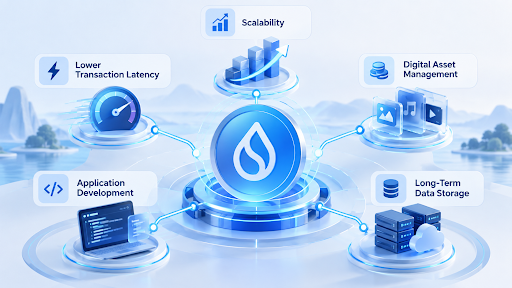
What Problems Does the Sui Blockchain Solve?
The Sui blockchain was designed to address several common challenges in blockchain applications, especially those involving high transaction volumes and large numbers of digital assets.
Its architecture focuses on several areas:
- Scalability. Sui parallel execution allows independent transactions to be processed at the same time instead of forcing all activity into a single sequence.
- Transaction latency. Different transaction types can use different processing paths, helping reduce unnecessary waiting when operations do not depend on the same objects.
- Digital asset management. The Sui object model gives assets explicit ownership and identity, which is useful for NFTs, gaming items, tokens, and other programmable resources.
- Application development. Sui Move provides developers with tools for building smart contracts and applications around digital assets and ownership rules.
- Long-term data storage. The Sui economic model includes a Storage Fund designed to account for the ongoing cost of storing blockchain data.
These components work together as part of the same architecture. Sui scalability depends not only on consensus speed, but also on how the network represents assets, separates independent transactions, and distributes processing workloads.
What Is the SUI Token and What Is SUI Used For?
SUI is the native token of the Sui network. It supports the economic and operational functions of the blockchain and is used for transaction fees, staking, governance, and interactions with decentralized applications.
The main uses of the SUI token include:
- Paying gas fees for transactions and smart contract interactions
- Staking and delegating tokens to validators
- Participating in governance processes
- Interacting with DeFi applications
- Using SUI within gaming, NFT, and other digital asset platforms
Gas fees are one of the core uses of SUI. Users pay fees when they transfer assets, interact with smart contracts, or perform other operations on the network. These fees help support transaction processing and network operation.
SUI is also used in staking. Validators participate in securing the network, while token holders can delegate SUI to validators. The amount of stake associated with a validator affects its role within the network during each epoch.
The token can also be used across decentralized applications built on Sui. Depending on the application, SUI may be used for trading, liquidity, lending, gaming-related payments, asset transfers, or other blockchain-based services.
SUI Tokenomics and Token Supply
SUI tokenomics describe how the token supply is structured and how SUI is distributed and used across the network. The total supply of SUI is capped at 10 billion tokens, while the circulating supply represents only the portion currently available in the ecosystem.
The circulating supply changes over time as tokens are released according to allocation schedules. For this reason, total supply and circulating supply should not be treated as the same metric.
Another important part of Sui tokenomics is the Storage Fund. Blockchain data must be stored over long periods, which creates infrastructure costs for validators. The Storage Fund is designed to account for these long-term storage requirements and connect data usage with the economic model of the network.
Sui also uses storage rebates. When eligible on-chain data is removed, part of the storage fee may be returned. This mechanism is intended to encourage more efficient use of blockchain storage.
How Is the Sui Blockchain Different From Other Blockchains?
The Sui blockchain differs from many Layer 1 networks mainly through its object-centric architecture and transaction processing model. Instead of representing most blockchain activity only through accounts and balances, Sui organizes many digital resources as individual objects.
This affects both asset management and transaction execution. Because the network can identify which objects are involved in each transaction, independent operations can often be processed in parallel instead of waiting for unrelated activity.
Sui also uses Move for smart contracts. The language was designed around digital resources and ownership rules, which makes it suitable for applications that manage programmable assets.
Compared with networks such as Ethereum, Solana, or Aptos, Sui combines several features within the same architecture: object-based data, parallel execution, Delegated Proof-of-Stake, Move smart contracts, and Mysticeti consensus.
These differences do not mean that Sui is automatically better than other blockchains. Different networks are designed around different technical priorities, developer environments, and application requirements.
Sui Ecosystem, DeFi, Gaming, and NFTs
The Sui ecosystem includes decentralized applications and services related to finance, digital ownership, gaming, and blockchain infrastructure. The object-centric model is particularly useful for applications where individual digital assets need to be created, transferred, modified, or owned by specific users.
Common categories within the Sui ecosystem include decentralized exchanges, lending platforms, wallets, NFT marketplaces, gaming projects, and other dApps. These applications use Sui smart contracts and the SUI token in different ways depending on their purpose.
DeFi applications can use SUI for trading, liquidity, borrowing, lending, and other financial operations. Gaming applications can use blockchain objects to represent in-game items, characters, collectibles, or other assets with defined ownership.
NFTs and other digital assets also fit naturally into the Sui object model. Instead of treating an NFT only as a balance or record, the network can represent it as a separate programmable object with its own attributes and ownership information.
Advantages and Limitations of Sui Cryptocurrency and Blockchain
Sui offers several technical features that distinguish it from many other Layer 1 networks. Its architecture is designed for applications that involve frequent asset interactions and high transaction activity.
The main advantages include:
- Parallel transaction execution for independent operations
- Object-based management of digital assets
- Move smart contracts
- Architecture designed for scalability
- Support for DeFi, gaming, NFTs, and other dApps
- Different processing paths for different transaction types
At the same time, Sui has limitations that should be considered. It is a relatively young blockchain compared with older networks such as Ethereum, which means its ecosystem, tooling, and developer community are still developing.
Sui also operates in a competitive Layer 1 market. Developers can choose from many networks with different technical models, liquidity levels, user bases, and application ecosystems.
Like other cryptocurrency platforms, Sui also carries technical and operational risks. Smart contract vulnerabilities, wallet security issues, protocol changes, and cryptocurrency market volatility can affect users and applications even when the underlying network continues to function normally.
FAQ About Sui (SUI) and the Sui Blockchain
Is SUI the Same as Sui? SUI and Sui are closely related, but they are not exactly the same thing. Sui refers to the blockchain network, its protocol, and the broader ecosystem built around it. SUI is the native cryptocurrency used within that network. The distinction matters because users can interact with the Sui blockchain through applications, wallets, NFTs, and other digital assets even when the discussion is not specifically about the SUI token. In crypto terminology, project names and token tickers are often used interchangeably in casual conversation, which can create confusion. When reading technical documentation or exchange listings, it is useful to check whether the reference is to the network itself or to the SUI asset.
Can SUI Tokens Be Transferred Between Different Wallets? SUI can generally be transferred between compatible wallets that support the Sui network. Before sending tokens, users should confirm that the destination address belongs to the correct blockchain and that the selected wallet supports SUI. Sending assets to an incompatible address or through the wrong network can result in loss of access to the funds. It is also useful to check the transaction fee and destination address carefully before confirming the transfer. For larger amounts, some users prefer to send a small test transaction first. Wallet interfaces may differ, but the underlying transfer still takes place through the Sui network.
Can SUI Be Stored on an Exchange? SUI can be held on cryptocurrency exchanges that support the asset, but this is different from holding it in a self-custody wallet. When SUI is stored on an exchange, the platform typically controls the private keys associated with the assets. This can be convenient for trading or account-based services, but users depend on the exchange's security, withdrawal rules, and availability. A self-custody wallet gives the user direct control over private keys or recovery credentials. The choice between exchange custody and self-custody depends on how the tokens are expected to be used. Users should understand the security responsibilities associated with each option before moving funds.
Are Sui Transactions Reversible? Confirmed blockchain transactions are generally not designed to be reversed in the same way as card payments or bank transfers. If SUI or another asset is sent to the wrong address, there may be no central authority capable of canceling the transaction. This makes address verification particularly important before sending funds. Users should also check whether they are interacting with the intended smart contract or decentralized application. Some applications may include their own recovery or refund mechanisms, but these depend on the specific service rather than the Sui blockchain itself. Transaction finality is therefore useful for settlement, but it also places more responsibility on the user.
What Fees Should Users Consider When Using Sui? Users may encounter several types of costs when interacting with the Sui ecosystem. Sui transactions include computation and storage costs, although in some cases these costs may be covered through sponsored transaction mechanisms. Some decentralized applications may also charge their own service, trading, liquidity, or protocol fees. Exchanges can add withdrawal or trading fees that are separate from blockchain costs. Cross-chain services or bridges may introduce additional charges depending on the route used. The final cost of an operation can therefore include more than the Sui network fee alone. Users should review the full transaction details before confirming an operation, especially when using third-party applications.
Can Sui Be Used With Hardware Wallets? SUI may be supported by hardware wallet solutions through compatible wallet software or integrations. Hardware wallets are designed to keep private keys isolated from ordinary internet-connected devices, which can reduce certain security risks. However, compatibility depends on the specific device, firmware version, and wallet application being used. Users should verify official support before transferring SUI to a hardware wallet setup. It is also important to protect the recovery phrase and never share it with websites, applications, or support representatives. Hardware wallets improve key management security, but they do not protect users from approving malicious smart contract interactions.
Can Tokens From Other Blockchains Be Used on Sui? Assets originating on other blockchains may sometimes be used within the Sui ecosystem through bridges or other cross-chain infrastructure. In these cases, the asset on Sui may be represented by a bridged or wrapped version rather than the original token on its native network. Cross-chain transfers introduce additional technical and security considerations because users depend on the bridge mechanism as well as both blockchain networks. Token contracts and asset representations should be checked carefully to avoid interacting with unofficial versions. Liquidity and application support can also vary between native and bridged assets. Users should verify the specific bridge, token contract, and supported destination before transferring assets across networks.
Comments
Sign in to join the conversation. Every comment is reviewed before it appears on the page.
Sign in to comment
You need an account to leave a comment. Sign in and your name will be used automatically.
No comments yet. Be the first to write one.