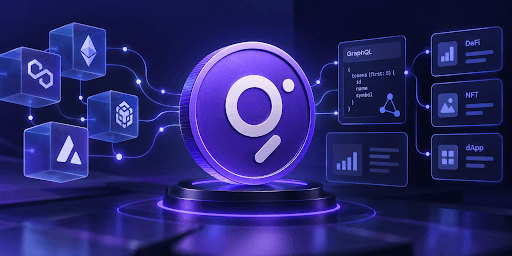
The Graph is a decentralized protocol designed to index and organize blockchain data so that applications can retrieve the information they need more efficiently. Instead of requiring developers to process large amounts of raw blockchain data independently, The Graph provides infrastructure for creating structured data sources that decentralized applications can query.
The protocol is widely associated with Web3 development and uses GRT as its native utility token. The Graph cryptocurrency helps coordinate participants who provide indexing, curation, and delegation services within the network. Technologies such as Subgraphs and GraphQL make it possible for applications to request specific blockchain information in a structured format.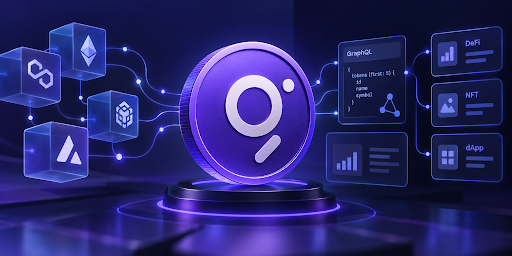
Using Cryptocurrency for Digital Purchases at Baxity Store
Baxity Store is a digital marketplace that connects cryptocurrency with practical online purchases. Instead of using digital assets only for trading, holding, or interacting with blockchain applications, customers can use supported cryptocurrency payment methods to purchase products such as gift cards, prepaid cards, gaming credits, and digital vouchers. This provides a familiar online shopping experience while expanding the ways cryptocurrency can be used for digital products and services.
The store offers products associated with popular gaming, shopping, entertainment, and payment platforms. Depending on the selected card or voucher, it can be used for subscriptions, games, digital content, account balances, online purchases, or other supported services. Available cryptocurrency payment methods may vary depending on the product, region, order, and checkout conditions, so customers should check the options displayed before completing a purchase.
With digital code delivery and a broad selection of products, Baxity Store provides a practical connection between cryptocurrency and everyday online spending. Users can select a suitable digital product, choose one of the currently supported payment methods at checkout, and receive the corresponding digital code without having to navigate complex blockchain services.
What Is The Graph Crypto (GRT)?
The Graph is a blockchain data indexing protocol that provides infrastructure for decentralized applications, or dApps. Blockchains contain large amounts of information about transactions, smart contracts, tokens, addresses, and other activity, but accessing specific data directly from a blockchain can require significant technical resources.
The Graph protocol addresses this problem by indexing selected blockchain data and making it available in an organized form. Applications can then request the information they need instead of repeatedly processing the underlying blockchain history themselves.
The Graph and GRT are related but different concepts. The Graph refers to the protocol, network, and indexing infrastructure, while GRT is the utility token used within its economic system. The GRT cryptocurrency helps coordinate participants who contribute resources and services to the network.
The Graph should not be confused with a blockchain explorer or a general internet search engine. Its primary purpose is to provide programmable blockchain data infrastructure that developers can integrate into Web3 applications.
The Graph History and Founders
The Graph was founded in 2018 by Yaniv Tal, Jannis Pohlmann, and Brandon Ramirez. The founders had previously worked together on software and developer-focused projects, and The Graph emerged from the challenge of making blockchain information easier for applications to access and organize.
The project initially developed around indexing data associated with Ethereum applications. Over time, its scope expanded as The Graph moved toward decentralized indexing infrastructure and support for a broader blockchain ecosystem. The launch of the decentralized network and the introduction of GRT created an economic model in which different participants could contribute to indexing and data delivery.
As blockchain applications expanded across multiple networks, The Graph also developed beyond its early association with Ethereum. This evolution has made multi-chain data indexing an important part of the protocol's broader role in Web3 infrastructure.
How Does The Graph Work as a Blockchain Indexing Protocol?
The Graph indexing protocol operates between blockchain networks and applications that need information from them. Instead of requiring a dApp to continuously search through raw blockchain records, The Graph organizes selected data so that it can be queried more efficiently.
The basic process can be represented as:
Blockchain data → Graph Node → indexing → Subgraph → query → dApp
Graph Nodes monitor supported blockchain networks and process relevant information according to instructions defined for a particular Subgraph. When events occur on the blockchain, such as transactions or changes involving smart contracts, the relevant information can be processed and added to the indexed dataset.
The main stages include:
- Blockchain monitoring. Infrastructure connected to The Graph reads information generated by supported blockchain networks.
- Data processing. Relevant blockchain events and smart-contract information are processed according to predefined indexing rules.
- Indexing. Processed information is organized so that applications can retrieve it efficiently.
- Querying. Applications send queries requesting particular information rather than processing an entire blockchain dataset.
- Data delivery. The requested information is returned to the application and can be displayed or used as part of its functionality.
This model is particularly useful for applications that repeatedly need historical or structured blockchain data. A DeFi interface, for example, may need information about tokens, transactions, positions, or protocol activity. Indexing allows the application to request the relevant information without independently rebuilding the entire data-processing infrastructure.
What Are The Graph Subgraphs and How Do They Work?
Subgraphs are a central part of The Graph protocol. A Subgraph defines which blockchain information should be indexed and how that information should be organized so that applications can retrieve it later.
Developers can create Subgraphs around specific smart contracts, protocols, or types of blockchain activity. For example, a decentralized finance application may need data about token transfers, liquidity positions, transactions, or changes generated by particular smart contracts. The corresponding Subgraph provides instructions for identifying and organizing that information.
A Subgraph is not a separate blockchain and does not replace the original blockchain data. The underlying transactions and state remain on their respective networks. The Subgraph creates an indexed representation of selected information that makes relevant data easier for applications to access.
This also means that different applications can require different Subgraphs. One may focus on trading activity, while another may organize information about digital assets, governance events, or other smart-contract interactions. The concept allows blockchain data indexing to be adapted to the requirements of individual Web3 applications.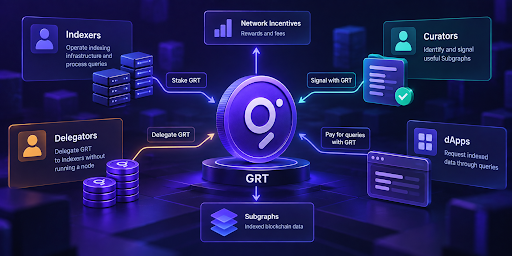
How The Graph Uses GraphQL for Blockchain Data
After blockchain information has been indexed, applications need a way to request specific data. The Graph uses GraphQL, a query language that allows applications to specify which information they want to retrieve.
Instead of requesting an entire dataset, a dApp can ask for selected fields relevant to a particular function or interface. This can reduce unnecessary data processing and allows developers to structure requests around the needs of their applications.
The relationship between the main components can be summarized as follows:
| Component | Function |
|---|---|
| Blockchain | Stores transactions, smart-contract activity, and network state |
| Graph Node | Processes relevant blockchain information |
| Subgraph | Defines which data should be indexed and how it is organized |
| GraphQL | Allows applications to query indexed information |
| dApp | Uses returned data in its interface or functionality |
GraphQL itself is not a blockchain technology created by The Graph. It is a query language used in many types of software applications. The Graph applies it to indexed blockchain information, giving developers a familiar method for requesting specific data from Subgraphs.
The Graph Indexers, Curators and Delegators
The decentralized network relies on different participants to organize, index, and provide access to blockchain data. GRT plays an important role in coordinating these participants and creating economic incentives for providing network services.
Three roles are particularly important:
- Indexers operate indexing infrastructure and provide indexing and query services. They commit GRT as part of their participation in the network and can receive rewards and fees according to the protocol's rules.
- Curators identify and signal Subgraphs that they consider useful or relevant for indexing. Their activity helps indicate where indexing resources may be valuable.
- Delegators assign GRT to Indexers without operating indexing infrastructure themselves. This allows them to participate in the network's economic model while relying on an Indexer to perform the technical role.
These roles are connected rather than operating independently. Curators can help identify useful data sources, Indexers provide the infrastructure required to index and serve data, and Delegators can support Indexers by delegating GRT. Rewards, fees, and other economic conditions depend on the participant's role and the current rules of The Graph network.
What Is GRT Token and What Is GRT Used For?
GRT is the native utility token associated with The Graph network. Its primary purpose is to coordinate participants involved in decentralized blockchain data indexing rather than simply functioning as a transferable digital asset.
Indexers use GRT as part of their participation in the network, while Delegators can assign GRT to Indexers. Curators also use GRT when signaling Subgraphs. These mechanisms connect the token with the indexing infrastructure and help create economic relationships between participants who request data and those who help organize and provide it.
GRT is therefore closely connected to the operation of The Graph protocol. Its utility depends on network mechanisms such as indexing, delegation, curation, incentives, and query-related economics. Specific rewards, fees, and participation requirements can change as the protocol develops, so current network parameters should be checked when evaluating a particular GRT use case.
The Graph Tokenomics and GRT Token Supply
The Graph tokenomics is designed around the use of GRT within the protocol's decentralized indexing economy. GRT is used by Indexers, Curators, and Delegators, while the network also includes mechanisms that can issue or remove tokens as part of its economic model. For this reason, GRT token supply should be considered in relation to both network participation and protocol activity.
The Graph launched GRT with an initial supply of 10 billion tokens. Since then, the supply has been affected by protocol issuance and mechanisms that remove GRT from circulation. Circulating supply differs from total supply because not every existing token is necessarily available in the market at a given time.
The protocol can also burn GRT through certain network mechanisms. However, token issuance and token burning operate alongside each other, so the burn rate alone does not indicate whether the overall supply is increasing or decreasing. Current GRT circulating supply and other supply metrics should therefore be checked using up-to-date network data.
The Graph Ecosystem and Use Cases
The Graph ecosystem provides data infrastructure for applications that need structured information from blockchain networks. In many cases, users may interact with services powered by indexed data without directly interacting with The Graph itself.
The Graph use cases can include:
- DeFi applications, which may require information about tokens, liquidity, transactions, and protocol activity
- Decentralized exchanges, which can use indexed data to display trading and market information
- Wallets, which may need organized transaction and asset data
- NFT applications and marketplaces, which can retrieve information about tokens, ownership, transfers, and collections
- Blockchain analytics tools, which can use indexed information to analyze on-chain activity
- Governance applications, which may retrieve proposal, voting, and participation data
- Other Web3 dApps, where blockchain information needs to be organized and presented efficiently
This makes The Graph primarily an infrastructure layer for developers and applications. An end user may simply see balances, transactions, market information, or other data in a dApp, while indexing and queries operate behind the interface.
The Graph vs Blockchain Explorers and Traditional APIs
The Graph, blockchain explorers, and traditional APIs can all provide access to data, but they serve different purposes. A blockchain explorer is generally designed to let users inspect transactions, addresses, blocks, smart contracts, and other activity through a website or similar interface.
The Graph indexing protocol is designed primarily for applications that need programmable access to organized blockchain data. Subgraphs allow developers to define relevant information, while queries can retrieve specific data for use inside a dApp. This makes The Graph different from manually searching for information through a blockchain explorer.
Traditional APIs can also provide applications with structured data, but they are often operated by centralized service providers. The Graph uses a decentralized network model in which different participants contribute to indexing and serving blockchain data. The choice between these approaches depends on the application's architecture, data requirements, supported networks, and other technical considerations.
The Graph Supported Blockchains and Multi-Chain Network
The Graph was initially closely associated with Ethereum and applications built within the Ethereum ecosystem. As Web3 expanded across more blockchain networks, The Graph developed into a broader multi-chain indexing infrastructure rather than remaining limited to a single blockchain.
Supported blockchains can use different architectures and may require different approaches to indexing. The Graph network provides developers with infrastructure for accessing data across supported environments while maintaining the core concept of organizing blockchain information for efficient querying.
The list of The Graph supported blockchains can change as integrations are introduced, updated, or discontinued. Developers should therefore consult current protocol documentation when determining whether a particular network can be indexed through The Graph rather than relying on historical lists of supported chains.
Advantages and Limitations of The Graph Protocol
The Graph protocol addresses a practical problem in Web3 development by making blockchain information easier for applications to organize and retrieve. Its decentralized indexing model also separates data infrastructure from the individual dApps that consume the information.
Some of its main characteristics include:
- Structured access to blockchain data
- Reusable Subgraphs for specific data requirements
- GraphQL-based queries
- Decentralized indexing infrastructure
- Support for applications across multiple blockchain ecosystems
- Economic coordination through the GRT token
The protocol also has limitations. Creating and maintaining indexing infrastructure can be technically complex, and applications depend on Subgraphs being configured and maintained correctly. Indexed information may not always become available at exactly the same moment as the underlying blockchain event, which can matter for applications that require very recent data.
The Graph also adds another infrastructure layer between blockchain networks and applications. Developers therefore need to consider indexing reliability, query availability, costs, and dependencies alongside the characteristics of the underlying blockchain and smart contracts.
The Graph Wallet: How to Store GRT Cryptocurrency
A GRT wallet is used to hold and transfer The Graph cryptocurrency. Depending on the wallet and service being used, it may also provide access to Web3 applications or other functions involving GRT.
Users can generally choose between self-custody wallets and custodial services that support GRT. With self-custody, the user controls the private keys or recovery phrase associated with the wallet and is responsible for protecting them. A custodial service manages the underlying wallet infrastructure on behalf of the account holder.
Before transferring GRT, users should confirm that both the sending and receiving services support the selected network and token format. The destination address should also be checked carefully because confirmed blockchain transfers are generally difficult or impossible to reverse. Private keys and recovery phrases should never be shared with another person or entered into an untrusted service.
How to Get GRT Cryptocurrency
GRT cryptocurrency can be obtained through cryptocurrency platforms that support the token or received from another user through a compatible blockchain transfer. Availability, payment methods, account requirements, and supported networks depend on the service and jurisdiction.
GRT can also enter the hands of network participants through mechanisms associated with The Graph protocol. Indexers, Delegators, and Curators may participate in different economic processes involving GRT, although requirements, fees, and rewards depend on their roles and current network parameters.
Before receiving or transferring GRT, users should verify wallet compatibility, the selected network, transaction costs, and withdrawal conditions. The Graph token may be supported in different blockchain environments, so checking the exact network on both sides of a transfer is important for avoiding compatibility problems.
FAQ About The Graph (GRT) Cryptocurrency and Protocol
Is The Graph a blockchain? The Graph is better understood as a decentralized protocol for organizing and accessing blockchain data rather than as a conventional Layer 1 blockchain such as Ethereum. It works with information generated by supported blockchain networks and makes selected data easier for applications to retrieve. This distinction is important because The Graph does not replace the networks whose information it indexes. Transactions and smart contract activity still occur on the underlying blockchain. The Graph provides an additional data layer that applications can use to find and process relevant information. As a result, describing The Graph simply as another blockchain can create an inaccurate impression of its primary function.
Is The Graph only for Ethereum? The Graph has strong historical connections with Ethereum, but its data infrastructure is not limited to Ethereum applications. The protocol has expanded to support a broader multi-chain environment as Web3 development has spread across different networks. Support can vary between networks and may change as new integrations are introduced. Developers should therefore check current documentation before assuming that a particular blockchain can be indexed using the same infrastructure. The availability of a network can also affect which development tools and indexing options can be used. This multi-chain approach allows The Graph to serve applications outside its original Ethereum-focused environment.
Can anyone create a Subgraph? Developers can create Subgraphs to define how particular blockchain information should be processed and made available for querying. Doing so requires technical knowledge because a Subgraph must identify relevant data sources and specify how blockchain events should be transformed into structured information. The developer also needs to understand the smart contracts or other on-chain components being indexed. A poorly configured Subgraph can return incomplete or incorrect information even when the underlying blockchain data itself is accurate. Testing and maintenance are therefore important parts of creating reliable indexing infrastructure. The exact deployment process and available tools can depend on the current version of The Graph's developer infrastructure.
What happens if a Subgraph stops working? A dApp that depends on a particular Subgraph may have difficulty retrieving the information normally supplied through that data source. The underlying blockchain transactions are not deleted because the original information remains recorded on the blockchain. Instead, the problem affects the application's ability to access or organize that information through the affected indexing configuration. Developers may need to investigate synchronization problems, configuration errors, changes to smart contracts, or other technical issues. Depending on the application, users might temporarily see outdated, incomplete, or unavailable information in its interface. This illustrates why dApps need to consider the reliability of their data infrastructure in addition to the reliability of the underlying blockchain.
Do dApp users interact with The Graph directly? In many cases, users can benefit from The Graph without knowing that an application relies on it. A user may open a DeFi interface, marketplace, wallet, or another Web3 service and see blockchain information that has been organized through indexing infrastructure. The query process takes place behind the application's interface rather than requiring the user to manually request data from The Graph. This is similar to other infrastructure technologies that support an online service without being visible during normal use. Developers are responsible for integrating the required data sources into their applications. As a result, direct interaction with The Graph is more relevant to developers and network participants than to many ordinary dApp users.
Is data from The Graph available in real time? Indexed blockchain information should not automatically be treated as perfectly instantaneous data. A blockchain event must first occur and then be processed by the relevant indexing infrastructure before an application can retrieve the updated information. This can create a difference between the latest blockchain state and the data currently available through a particular query. The size of that difference can depend on the network, indexing configuration, application, and current operating conditions. For applications where timing is important, developers may need to consider how recently the requested data was indexed. Users should also distinguish an indexing delay from a failed blockchain transaction because these are different technical situations.
Can The Graph index data from multiple blockchains? The Graph can provide indexing infrastructure across multiple supported blockchain ecosystems, but support should not be assumed for every existing network. Different blockchains have different architectures, data structures, and development environments, which can affect how indexing is implemented. An application operating across several networks may therefore need appropriate indexing configurations for each supported environment. Multi-chain indexing can be useful for applications that aggregate information from different blockchain ecosystems into one interface. Developers should verify current network support and available tooling before designing such an application around The Graph. This is especially important because the list of supported networks can evolve as the protocol and wider Web3 ecosystem develop.
Can GRT be sent to any crypto wallet? A wallet must support the appropriate token and network configuration before it can safely receive GRT. The fact that a wallet supports cryptocurrencies in general does not mean that every GRT transfer route will be compatible with it. Users should verify the receiving network, address format, and deposit instructions before initiating a transaction. Sending a token through an unsupported network can make recovery difficult and, in some situations, impossible without assistance from the receiving service. When using an unfamiliar wallet or transfer route, a small test transaction can help confirm compatibility before moving a larger amount. Users should never rely only on the appearance of an address when determining whether a transfer is supported.
How can you check a GRT transaction? A blockchain explorer compatible with the network used for the transfer can usually be used to inspect a GRT transaction. Users can search using information such as a transaction hash or wallet address to review the status of the transfer. The available details may include sender and recipient addresses, transferred amount, transaction fee, block information, and confirmation status. A successful blockchain transaction does not always mean that a custodial platform will immediately display the deposit because the service may require additional confirmations or internal processing. If funds have not appeared, checking the on-chain transaction can help determine whether the issue is related to the blockchain or the receiving service. Private keys and recovery phrases are not required to check a public transaction and should never be shared for this purpose.
Can a GRT transaction be reversed? A confirmed blockchain transfer of GRT generally cannot be canceled in the same way as a traditional card payment. Once the transaction has been recorded by the relevant blockchain network, there is normally no central administrator who can simply undo it. If GRT is sent to the wrong address, recovery may depend on whether someone controls that address and is willing or able to return the funds. Transfers involving an unsupported network or custodial service may sometimes require assistance from the receiving platform, but recovery is not guaranteed. Users should carefully verify the destination address, network, and token before confirming a transfer. For larger transfers, sending a small amount first can reduce the risk associated with an incorrect destination or incompatible network.
Comments
Sign in to join the conversation. Every comment is reviewed before it appears on the page.
Sign in to comment
You need an account to leave a comment. Sign in and your name will be used automatically.
No comments yet. Be the first to write one.