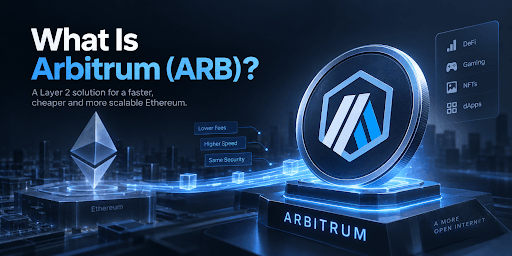
Ethereum is one of the largest platforms for smart contracts and decentralised applications, but high network activity can increase transaction fees and limit capacity. Arbitrum addresses these constraints by processing transactions on Layer 2 while using Ethereum for settlement and data availability. This approach can provide lower costs and greater scalability without requiring an independent Layer 1 blockchain.Arbitrum is an ecosystem rather than a single network, while ARB is its governance token. The ecosystem includes Arbitrum One, Arbitrum Nova and infrastructure for dedicated chains. Understanding the distinction between the technology and the ARB token is essential to understanding how Arbitrum works.
Using Cryptocurrency for Digital Purchases at Baxity Store
Baxity Store provides a practical way to use supported cryptocurrencies for everyday digital purchases. Instead of limiting digital assets to trading, investing, or blockchain applications, customers can use available crypto payment methods to purchase products such as gift cards, prepaid payment solutions, gaming products, and other digital goods. This creates a familiar way to turn cryptocurrency into purchasing power for online shopping, entertainment, subscriptions, and digital services. Baxity Store also offers crypto-related cards and vouchers connected to popular digital platforms and payment ecosystems. Depending on the product, these options can provide access to online services, gaming balances, subscriptions, and other digital purchases. With support for multiple cryptocurrency payment methods and fast delivery of digital codes, Baxity Store helps bridge the gap between cryptocurrency ownership and practical online spending without requiring users to navigate complex blockchain applications.
What Is Arbitrum (ARB)?
Arbitrum is an Ethereum scaling ecosystem developed by Offchain Labs, a company founded by Ed Felten, Steven Goldfeder and Harry Kalodner. Instead of executing every transaction directly on Ethereum Layer 1, Arbitrum processes much of the activity on Layer 2 and submits the necessary data to Ethereum. This architecture reduces reliance on limited Ethereum block space for individual transactions. Many Layer 2 operations can be grouped together, allowing Ethereum-related costs to be distributed across a larger number of transactions. Arbitrum therefore provides additional execution capacity while remaining closely connected to Ethereum. Arbitrum One launched on mainnet in 2021, while the ARB cryptocurrency was introduced in March 2023 as part of the transition towards decentralised governance. ARB is primarily a governance token and is not the standard gas currency on Arbitrum One, where users generally pay transaction fees in ETH.
Arbitrum (ARB) Key Facts
| Feature | Information |
|---|---|
| Project | Arbitrum |
| Token | ARB |
| Token launch | March 2023 |
| Network type | Ethereum Layer 2 ecosystem |
| Developer | Offchain Labs |
| Main network | Arbitrum One |
| Core technology | Optimistic rollups |
| Standard gas token on Arbitrum One | ETH |
| Primary ARB utility | Governance |
| Smart contract environment | EVM compatible |
Arbitrum differs from independent Layer 1 cryptocurrencies because it is designed to scale Ethereum rather than replace it. Its rollup infrastructure uses Ethereum as the underlying settlement and data availability layer.
How Does Arbitrum Work as an Ethereum Layer 2?
Arbitrum moves transaction execution away from Ethereum Layer 1 while publishing the necessary transaction data to Ethereum. Users interact with applications on Layer 2, where operations can be processed more efficiently and grouped into batches before their data is submitted to the underlying blockchain. A simplified Arbitrum transaction process includes:
- A user submits a transaction to Arbitrum.
- The sequencer receives and orders transactions.
- Transactions are executed on Layer 2.
- Transaction data is compressed and submitted to Ethereum in batches.
- Ethereum provides the underlying settlement and data availability.
Batching is central to Arbitrum Ethereum scaling. Instead of each operation independently consuming Layer 1 resources, Ethereum costs can be shared across many transactions. Actual Arbitrum transaction fees still vary according to Layer 2 activity, Ethereum data costs and other network conditions.
Arbitrum Optimistic Rollup Technology
Arbitrum One uses optimistic rollups. The protocol does not require every Layer 2 computation to be repeated on Ethereum. Instead, state assertions are accepted unless they are successfully challenged. If an invalid assertion is submitted, Arbitrum's fraud-proof mechanism provides a way to resolve the disputed computation. This model reduces the amount of computation that must take place directly on Ethereum while maintaining a mechanism for enforcing correct execution. The challenge mechanism also affects withdrawals. Native withdrawals from Arbitrum One to Ethereum through the canonical rollup process are subject to a challenge period, commonly around seven days. This should not be confused with ordinary transactions within Arbitrum, which are processed much faster.
Sequencer, Nitro and Transaction Processing
The Arbitrum sequencer receives and orders transactions, helping provide users with fast preliminary confirmations before batches are ultimately posted to Ethereum. This contributes to the faster user experience associated with Arbitrum Layer 2 applications. Arbitrum One runs on the Nitro technology stack and maintains close compatibility with Ethereum. Its EVM-compatible environment allows developers to deploy many Solidity smart contracts and use familiar Ethereum development tools without rebuilding applications for an unrelated blockchain architecture.
Arbitrum One, Arbitrum Nova and the Arbitrum Ecosystem
Arbitrum includes multiple networks and technologies rather than only Arbitrum One. Arbitrum One is the primary general-purpose Layer 2 network, while Arbitrum Nova uses a different architecture aimed at applications where particularly low transaction costs are important. The ecosystem also provides technology for building dedicated chains.
Arbitrum One
Arbitrum One uses the Rollup protocol and publishes transaction data to Ethereum. It supports EVM-compatible smart contracts and applications across areas such as DeFi, stablecoins, exchanges, gaming and other Web3 services. Its close Ethereum compatibility allows developers to use familiar languages, wallets and development tools. This has helped Arbitrum One become an established environment for applications that need greater scalability than direct Ethereum Layer 1 execution can provide.
Arbitrum Nova
Arbitrum Nova uses the AnyTrust protocol. Under normal conditions, a Data Availability Committee helps provide transaction data availability, reducing the amount of data that needs to be published directly to Ethereum and allowing lower transaction costs. This creates a different trust model from Arbitrum One. If the required committee conditions are not satisfied, the system can fall back to posting data on Ethereum. Nova is particularly suited to high-volume applications where transaction costs are a major consideration.
Arbitrum Dedicated Chains and Stylus
Arbitrum technology can also support dedicated chains configured for specific applications or organisations. Depending on the implementation, developers can customise elements such as governance, data availability and gas-token choices. Arbitrum Stylus expands the available development environment by supporting smart contracts written in languages such as Rust, C and C++ alongside traditional EVM development. Stylus contracts can interoperate with EVM contracts, allowing developers to use additional programming languages without separating applications from the broader Arbitrum ecosystem.
What Is the ARB Token Used For?
ARB is primarily the governance token of the Arbitrum ecosystem. Unlike ETH, which is generally used to pay gas fees on Arbitrum One, ARB gives holders the ability to participate in decentralised governance. The main functions of the ARB token include:
- voting on eligible Arbitrum DAO proposals;
- delegating voting power to governance representatives;
- participating in decisions concerning DAO treasury resources;
- influencing protocol and governance changes;
- participating in governance processes related to bodies such as the Security Council.
This distinction between ARB and ETH is important. Users do not generally need ARB simply to make transactions or interact with applications on Arbitrum One. ARB token utility is primarily associated with governance and influence over the ecosystem.
ARB Governance and Arbitrum DAO
The Arbitrum DAO allows ARB holders to vote on Arbitrum Improvement Proposals or delegate their voting power to other participants. Delegation does not require holders to transfer ownership of their tokens, making it possible to participate indirectly through representatives. The DAO also governs treasury resources used for ecosystem initiatives and can consider technical, financial and governance proposals within its authority. The Security Council adds another layer to the governance structure and is designed to respond to certain urgent technical situations under governance-defined rules.
ARB Tokenomics and Token Distribution
ARB launched in March 2023 with an initial supply of 10 billion tokens. The initial distribution allocated tokens across the Arbitrum DAO Treasury, Offchain Labs team and future team members, investors, individual users and DAOs within the ecosystem. Approximately 42.8% of the initial allocation went to the DAO Treasury, 26.9% to the Offchain Labs team and future team members, 17.5% to investors, 11.6% to individual user addresses through the airdrop and 1.1% to DAOs in the Arbitrum ecosystem. Team and investor tokens were subject to vesting rather than becoming fully available at launch.
ARB Supply and Unlocks
ARB's circulating supply changes as previously locked tokens become available. This means circulating supply should not be confused with the initial 10 billion token figure or with the amount allocated to particular groups. Token unlocks increase the amount of ARB that can potentially enter circulation, but an unlock does not mean the tokens are immediately sold or traded. When considering ARB tokenomics, allocation, vesting, unlocked supply and circulating supply should therefore be treated as separate concepts.
Arbitrum Transaction Fees, Speed and Scalability
Arbitrum is designed to reduce the cost of using Ethereum-based applications by processing transactions on Layer 2 and sharing Ethereum-related costs across batches of transactions. Users generally pay lower fees on Arbitrum One than they would for comparable activity directly on Ethereum mainnet, although the actual difference varies with network conditions. Arbitrum gas fees have two main cost components: the resources required to execute a transaction on Layer 2 and the cost associated with publishing transaction data to Ethereum. As a result, fees can change when activity or data costs on Ethereum increase. Arbitrum does not provide a fixed transaction price, and the cost of a transfer, token swap or smart contract interaction can differ. Scalability also improves the user experience by allowing Arbitrum to process substantially more activity without requiring every operation to be executed individually on Ethereum Layer 1. The sequencer provides rapid ordering and preliminary confirmation of transactions, while batches are subsequently posted to Ethereum. Transaction speed within Arbitrum should not be confused with the longer challenge period involved in canonical withdrawals from an optimistic rollup to Ethereum.
ETH and ARB Roles in Arbitrum Transactions
ETH and ARB perform different functions in the Arbitrum ecosystem. On Arbitrum One, ETH is the standard token used to pay gas fees, while ARB primarily provides governance rights. Users therefore need ETH on the appropriate network to cover transaction costs when transferring assets or interacting with most applications. This distinction is important because the term Arbitrum cryptocurrency can create the impression that ARB powers every network operation. In practice, ARB is not required for ordinary gas payments on Arbitrum One, and its principal utility remains participation in governance.
Arbitrum Bridge and How to Use Arbitrum
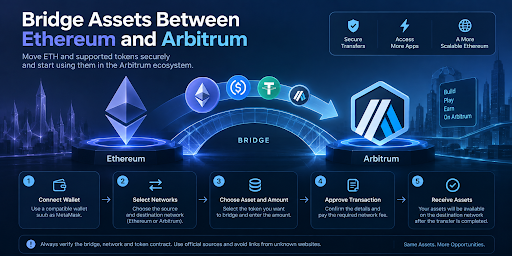
Users who want to move assets between Ethereum and Arbitrum can use bridging infrastructure. A bridge locks or otherwise accounts for assets on one network and makes the corresponding value available on another, allowing ETH and supported tokens to move between Ethereum and Arbitrum. The official Arbitrum bridge supports transfers between Ethereum and supported Arbitrum networks. Depositing assets from Ethereum to Arbitrum requires an Ethereum transaction, while moving assets back through the canonical Arbitrum One withdrawal mechanism involves the optimistic rollup challenge period. Users should also make sure that their wallet is connected to the correct network before transferring or interacting with assets.
Moving Assets Between Ethereum and Arbitrum
The basic process of using an Ethereum to Arbitrum bridge usually involves connecting a compatible wallet, selecting the source and destination networks, choosing an asset and amount, and approving the required transaction. Once the transfer is completed, the bridged assets can be used with applications on the destination network. Third-party bridges can provide alternative routes and, in some cases, faster transfers, but they may introduce additional smart contract, liquidity or counterparty risks. Users should verify the bridge, network and token contract rather than relying on links received through advertisements, messages or unfamiliar websites.
Wallets and ARB Storage
ARB is an ERC-20 compatible token and can be stored using wallets that support the relevant Ethereum and Arbitrum networks. Self-custody wallets give users direct control over their private keys, while custodial platforms manage those credentials on behalf of customers. When storing or transferring ARB, users should confirm which network is being used because exchanges and wallets may support multiple withdrawal options. Sending an asset through an unsupported network can make recovery difficult or impossible. Protecting seed phrases, verifying addresses and avoiding unverified token contracts are therefore important parts of managing ARB and other digital assets.
Arbitrum DeFi, Smart Contracts and Other Use Cases
The Arbitrum ecosystem supports applications that require Ethereum compatibility but can benefit from lower transaction costs and greater capacity. Its EVM-compatible environment allows developers to deploy smart contracts using familiar Ethereum tools, making Arbitrum suitable for both existing projects and applications built specifically for Layer 2. Common Arbitrum use cases include:
- decentralised exchanges and token swaps;
- lending and borrowing protocols;
- stablecoins and payment applications;
- derivatives and other decentralised financial services;
- blockchain games and digital assets;
- NFTs and marketplaces;
- tokenisation and other smart contract applications.
Arbitrum DeFi is one of the most prominent parts of the ecosystem because financial applications can require frequent smart contract interactions that become costly on Ethereum during periods of high demand. Lower transaction costs can make activities such as swaps, deposits and other on-chain operations more practical, although users remain exposed to the risks of the individual smart contracts and protocols they choose. Beyond DeFi, Arbitrum smart contracts can support gaming, digital ownership, payments and other Web3 services. Dedicated Arbitrum chains and technologies such as Stylus further expand the range of applications developers can build within the broader ecosystem.
Arbitrum vs Ethereum and Other Layer 2 Networks
Arbitrum vs Ethereum is not a comparison between two equivalent Layer 1 blockchains. Ethereum provides the base blockchain, while Arbitrum One operates as a Layer 2 network designed to increase Ethereum's execution capacity. Arbitrum relies on Ethereum for settlement and data availability in its rollup architecture rather than replacing it. The practical differences are most visible in transaction execution and costs. Ethereum processes transactions directly on Layer 1, while Arbitrum executes transactions on Layer 2 and batches data for submission to Ethereum. This generally makes Arbitrum transactions less expensive while allowing users to interact with an environment closely compatible with Ethereum.
| Feature | Arbitrum One | Ethereum |
|---|---|---|
| Network layer | Layer 2 | Layer 1 |
| Primary role | Ethereum scaling | Base blockchain |
| Transaction execution | Layer 2 | Layer 1 |
| Settlement | Ethereum | Native |
| Standard gas token | ETH | ETH |
| Governance token | ARB | No equivalent protocol governance token |
| Typical transaction costs | Generally lower | Generally higher |
The relationship is therefore complementary. Ethereum supplies the underlying Layer 1 infrastructure, while Arbitrum provides additional execution capacity for applications and users seeking lower costs.
Arbitrum vs Optimism, Base and Other Layer 2 Networks
Arbitrum is one of several ecosystems designed to scale Ethereum. Optimism also uses optimistic rollup technology, while Base is an Ethereum Layer 2 built using the OP Stack. Other networks use zero-knowledge rollup technology, where cryptographic validity proofs play a central role in verifying state transitions. These Layer 2 networks differ in architecture, governance, development frameworks, interoperability strategies and ecosystem composition. The appropriate network depends on the application and user requirements, so the distinction cannot be reduced to transaction fees alone.
Advantages, Limitations and Safety of Arbitrum
Arbitrum combines Ethereum compatibility with Layer 2 scalability, but using an additional blockchain layer also introduces technical and operational considerations. Its benefits should therefore be evaluated together with the risks associated with rollups, bridges, smart contracts and decentralised applications.
Advantages of Arbitrum
The main advantages include:
- generally lower transaction fees than comparable operations on Ethereum mainnet;
- increased capacity for applications with frequent on-chain interactions;
- EVM compatibility and support for familiar Ethereum development tools;
- access to a broad ecosystem of DeFi and Web3 applications;
- settlement and data availability through Ethereum for Arbitrum One;
- infrastructure for dedicated chains and additional development options through Stylus.
These characteristics make Arbitrum useful for applications that want to remain within the Ethereum ecosystem while reducing the cost and capacity constraints associated with direct Layer 1 execution.
Arbitrum Risks and Limitations
Arbitrum does not eliminate blockchain risk. Users can still lose assets because of vulnerable smart contracts, compromised wallets, phishing attacks or interactions with fraudulent tokens and applications. Bridges introduce another layer of complexity because transferring assets between networks can involve additional contracts and infrastructure. Layer 2 systems also have their own operational and security assumptions. Arbitrum's architecture includes components such as the sequencer and upgrade mechanisms, while Arbitrum Nova introduces additional data availability assumptions through its committee model. Users should therefore consider both the security properties of the underlying network and the risks of the specific applications they use.
The Future of Arbitrum and ARB
The future development of Arbitrum is closely connected to the broader effort to scale Ethereum. Arbitrum One remains a central part of the ecosystem, while dedicated chains extend the technology to projects that require more control over their blockchain infrastructure. Stylus also expands development options by allowing smart contracts to be written in additional programming languages. ARB is likely to remain closely associated with governance as the ecosystem develops. Changes to the protocol, treasury programmes and governance mechanisms can affect how holders participate in decision-making, but technological growth does not guarantee an increase in the market value of ARB. The future of the token and the future adoption of Arbitrum technology should therefore be considered as related but separate questions.
Conclusion
Arbitrum is an Ethereum Layer 2 ecosystem designed to increase blockchain capacity while reducing the cost of many transactions. Arbitrum One uses optimistic rollup technology to execute transactions on Layer 2 and rely on Ethereum for settlement and data availability, while Nova, dedicated chains and Stylus extend the ecosystem to additional use cases and development models. ARB has a distinct role within this infrastructure. Rather than serving as the standard gas token on Arbitrum One, it primarily enables participation in Arbitrum governance. As blockchain technology develops beyond trading and decentralised applications, services such as Baxity Store also demonstrate how supported cryptocurrencies can connect digital assets with practical online purchases, including gift cards, gaming products and other digital goods.
Arbitrum (ARB) FAQ: Common Questions About the Token and Network
Can ARB be mined?
ARB cannot be mined in the same way as Proof of Work cryptocurrencies such as Bitcoin. The token was created as part of Arbitrum's governance system rather than through a mining process. Arbitrum One also does not depend on ARB miners to validate transactions or produce blocks. Transaction execution and settlement follow the Layer 2 architecture described by the Arbitrum protocol and ultimately rely on Ethereum. Users who want to obtain ARB generally need to receive it from another wallet, buy it through a supported trading platform, or participate in an eligible distribution or ecosystem programme. This means ARB supply dynamics are determined by token allocation and governance rules rather than mining rewards.
Is ARB an ERC-20 token?
ARB is an ERC-20 compatible token associated with the Ethereum ecosystem. This compatibility allows it to interact with wallets, exchanges and smart contracts that support the ERC-20 token standard. However, users should still check the network on which they are sending or receiving ARB because the token may be supported across more than one compatible network environment. A wallet showing the correct token name does not automatically guarantee that the selected network is correct. Users should verify the contract address and network information using an official or trusted source before making a transfer. This is particularly important when moving ARB between an exchange and a self-custody wallet.
Can ARB be staked to earn network rewards?
ARB is not used in a conventional Proof of Stake system where validators lock the token to secure Arbitrum One and earn protocol rewards for block validation. Its main role is governance, so holding ARB does not automatically generate staking income from the network. Some third-party DeFi platforms may offer lending, liquidity or reward programmes involving ARB, but those arrangements are separate from the core Arbitrum protocol. Returns offered by such services can involve smart contract, liquidity, market and counterparty risks. Users should therefore distinguish between native protocol staking and yield opportunities created by external applications. Any advertised ARB yield should be evaluated based on the specific platform providing it.
Can ARB be used on Ethereum mainnet?
ARB can exist and be transferred within the broader Ethereum-compatible environment, including Ethereum mainnet and supported Arbitrum networks. The same token may therefore appear in different wallet contexts depending on where it is held. However, transaction costs and available applications can differ significantly between networks. Using ARB on Ethereum mainnet requires ETH for Ethereum gas fees, while activity on Arbitrum One also generally requires ETH on that network. Users should not assume that having ETH on Ethereum automatically gives them ETH for gas on Arbitrum, because balances are network specific. Before interacting with ARB, it is useful to confirm both the token balance and the gas balance on the selected network.
What happens if the Arbitrum sequencer becomes unavailable?
A sequencer outage can affect how quickly users receive transactions and confirmations on an Arbitrum network, but it does not mean that ownership records disappear. Rollup systems are designed with mechanisms that allow users to rely on Ethereum rather than permanently depending on a single sequencer interface. During an outage, normal transaction submission may become slower or less convenient until regular sequencer service resumes. The exact fallback process depends on the network and current protocol implementation. Users should therefore check official Arbitrum status information if transactions appear delayed unexpectedly. Temporary sequencer disruption is an operational issue that should be distinguished from a loss of assets or a failure of Ethereum settlement.
Does owning ARB give holders ownership of Offchain Labs?
Holding ARB does not give a user shares or equity in Offchain Labs. ARB is a governance token for the Arbitrum ecosystem, not a traditional security representing ownership in the company that originally developed the technology. Token holders may have voting rights within the scope of Arbitrum DAO governance, but those rights are different from shareholder rights in a corporation. ARB holders do not automatically receive company profits, dividends or claims on Offchain Labs assets. Governance authority is also limited by the rules and processes defined for the DAO and related protocol structures. This distinction is important because ownership of a governance token should not be interpreted as ownership of the company behind the original software.
Can ARB tokens be permanently lost?
Yes, ARB can become effectively unrecoverable if users lose access to the private keys controlling a self-custody wallet. Tokens can also be lost if they are sent to an incompatible address or unsupported network and no recovery method is available. Blockchain transactions are generally irreversible once confirmed, so there is no central administrator who can simply cancel an incorrect transfer. Seed phrases and private keys should therefore be stored securely and never shared with websites, support agents or other people. A small test transfer can reduce the risk when sending ARB to a new wallet or platform for the first time. Users should also confirm that the receiving service supports both ARB and the selected blockchain network before transferring larger amounts.




Comments
Sign in to join the conversation. Every comment is reviewed before it appears on the page.
Sign in to comment
You need an account to leave a comment. Sign in and your name will be used automatically.
No comments yet. Be the first to write one.