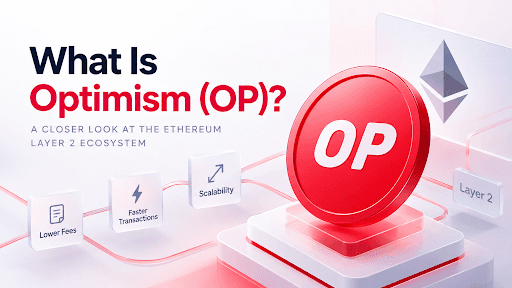
Optimism is an Ethereum Layer 2 ecosystem designed to make blockchain transactions faster, cheaper, and more scalable. Its original network, OP Mainnet, processes transactions outside Ethereum Layer 1 and publishes relevant data back to Ethereum, reducing congestion while relying on the base network for settlement and security. Today, Optimism crypto includes more than OP Mainnet. The ecosystem also consists of the OP Stack, the Superchain, and the OP token used for governance. Together, these components have expanded Optimism from a single Ethereum scaling solution into infrastructure for building interconnected Layer 2 networks.
Using Cryptocurrency for Digital Purchases at Baxity Store
Baxity Store provides a practical way to use supported cryptocurrencies for everyday digital purchases. Instead of limiting digital assets to trading, investing, or blockchain applications, customers can use available crypto payment methods to purchase products such as gift cards, prepaid payment solutions, gaming products, and other digital goods. This creates a familiar way to turn cryptocurrency into purchasing power for online shopping, entertainment, subscriptions, and digital services. Baxity Store also offers crypto-related cards and vouchers connected to popular digital platforms and payment ecosystems. Depending on the product, these options can provide access to online services, gaming balances, subscriptions, and other digital purchases. With support for multiple cryptocurrency payment methods and fast delivery of digital codes, Baxity Store helps bridge the gap between cryptocurrency ownership and practical online spending without requiring users to navigate complex blockchain applications.
What Is Optimism Crypto and What Is OP Mainnet?
Optimism is an Ethereum Layer 2 ecosystem created to increase transaction capacity without requiring every operation to be executed directly on Ethereum. OP Mainnet is its original Layer 2 blockchain, where transactions can generally be processed faster and at lower cost than on Ethereum Layer 1. OP Mainnet is EVM-equivalent, allowing developers to use familiar Ethereum tools and deploy decentralized applications across areas such as DeFi, NFTs, and payments. The broader Optimism ecosystem is coordinated through the Optimism Collective and has expanded beyond OP Mainnet through the development of the OP Stack and Superchain. The OP token is separate from the network itself. It primarily serves governance functions, while ETH is used to pay standard gas fees on OP Mainnet.
How Does Optimism Work as an Ethereum Layer 2?
Optimism works by moving transaction execution to Layer 2 while using Ethereum for settlement and data availability. OP Mainnet uses optimistic rollup technology to process transactions, group their data into batches, and publish that data to Ethereum. This architecture reduces the amount of Ethereum block space required per individual transaction. As a result, Optimism transaction fees can generally be lower while applications remain closely integrated with the Ethereum ecosystem.
How Optimism Processes Transactions
When a transaction is submitted to OP Mainnet, a sequencer orders it and includes it in a Layer 2 block. Transaction data from multiple operations is subsequently compressed and submitted to Ethereum in batches. The process can be simplified into five steps:
- A user sends a transaction on OP Mainnet.
- The sequencer orders and processes transactions.
- OP Mainnet updates its Layer 2 state.
- Transaction data is compressed and batched.
- The required data is published to Ethereum.
This batching mechanism is a major source of Optimism scalability because the cost of interacting with Ethereum can be distributed across many Layer 2 transactions.
Optimistic Rollups and Fault Proofs
Optimistic rollups assume proposed state transitions are valid unless successfully challenged. Instead of requiring a validity proof for every batch, the system provides a period during which potentially incorrect state claims can be disputed. Optimism uses fault proofs to resolve such disputes through Ethereum. Permissionless fault proofs allow participants to challenge invalid state claims without belonging to a predefined group. This model also creates an important trade-off. Standard withdrawals from OP Mainnet to Ethereum can require a challenge period, making them considerably slower than ordinary Layer 2 transactions. Third-party bridges may provide faster transfers but introduce their own fees and risks.
Optimism OP Stack, OP Chains and the Superchain
Optimism has developed beyond a single blockchain through the OP Stack, an open-source framework that other projects can use to create Ethereum Layer 2 networks. Chains using this technology are commonly known as OP Chains and form the technological foundation of the Optimism Superchain.
What Is the OP Stack?
The OP Stack is a modular software framework for building Layer 2 blockchains. Instead of developing an entire rollup infrastructure independently, projects can use standardized OP Stack components for areas such as execution, settlement, and data availability. OP Mainnet is built using the OP Stack, but the technology is also used by other networks. Examples include Base, Unichain, World Chain, Soneium, and Zora. Individual OP Stack chains can have different operators, applications, governance arrangements, and economic models.
What Is the Optimism Superchain?
The Optimism Superchain is an ecosystem of OP Chains built around shared technical standards. Its goal is to reduce fragmentation between Layer 2 networks and improve interoperability while allowing individual chains to maintain their own applications and communities. The Superchain is therefore not one blockchain. It is a broader network of compatible chains, with interoperability infrastructure being developed to make communication and asset transfers between them more seamless. This strategy means the growth of Optimism can increasingly depend on adoption of the OP Stack across the wider Ethereum ecosystem, rather than activity on OP Mainnet alone.
What Is the OP Token and How Does Optimism Tokenomics Work?
OP is the governance token of the Optimism Collective. Token holders can participate in ecosystem governance or delegate their voting power to other participants. OP is not the standard gas token of OP Mainnet, where transaction fees are paid in ETH.
| Characteristic | Optimism (OP) |
|---|---|
| Ticker | OP |
| Token standard | ERC-20 |
| Primary role | Governance |
| Governance | Optimism Collective |
| Gas token on OP Mainnet | ETH |
| Initial supply | 4,294,967,296 OP |
| Ecosystem | Optimism / Superchain |
OP Token Utility and Governance
OP token utility centres primarily on governance. Holders can vote or delegate their voting power, while the Optimism Collective coordinates decisions concerning ecosystem development and funding. Optimism uses a bicameral governance structure consisting of the Token House and Citizens' House. The model is designed to combine token-based governance with broader participation in decisions involving public goods and ecosystem development.
OP Token Supply and Economic Model
OP launched with an initial supply of approximately 4.295 billion tokens. The allocation included ecosystem funding, retroactive public goods funding, user airdrops, core contributors, and investors. Circulating supply changes as tokens from these allocations are distributed according to their respective mechanisms. The economic model has continued to evolve. In 2026, Optimism governance approved a program that uses part of eligible Superchain revenue for OP token buybacks, creating a more direct connection between ecosystem activity and OP. However, governance remains the token's primary function, while its broader economic role depends on factors including Superchain growth, OP Stack adoption, token supply, and future governance decisions.
Optimism Transaction Fees, Speed and Scalability
Optimism transaction fees are generally lower than fees on Ethereum Layer 1 because OP Mainnet processes transactions separately and publishes compressed transaction data to Ethereum in batches. Instead of each user paying the full cost associated with direct Layer 1 execution, many Layer 2 transactions can share part of the cost of using Ethereum. Gas fees on OP Mainnet are paid in ETH. The total cost of a transaction can include the cost of execution on Layer 2 and the cost of publishing the necessary data to Ethereum. This means Optimism gas fees can still change depending on network activity, transaction type, and conditions on Ethereum. Optimism transaction speed is also typically higher from the user's perspective because transactions are sequenced and confirmed on Layer 2 before their data is finalized through Ethereum. This architecture improves Optimism scalability and allows decentralized applications to serve more users without relying entirely on Ethereum Layer 1 capacity.
Optimism Bridge and How to Use Optimism
Users can move supported assets between Ethereum and OP Mainnet through bridging infrastructure. The Optimism bridge connects the two networks and allows users to deposit assets into the Layer 2 environment or withdraw them back to Ethereum.
Bridging Assets to OP Mainnet
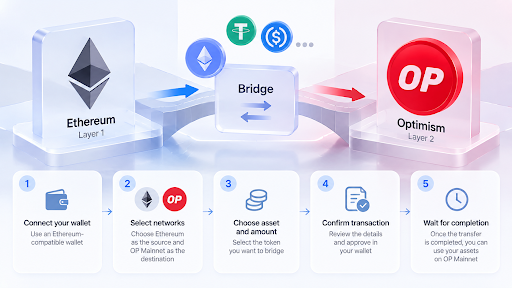
To use Optimism, a user typically needs an Ethereum-compatible wallet that supports OP Mainnet. Assets can then be transferred from Ethereum through a supported bridge. ETH is particularly important because it is required to pay gas fees after funds arrive on OP Mainnet. The basic process normally involves:
- Connecting a compatible wallet to a bridge.
- Selecting Ethereum as the source network and OP Mainnet as the destination.
- Choosing the supported asset and amount.
- Confirming the transaction in the wallet.
- Waiting for the transfer to be completed before using the assets on OP Mainnet.
Users should verify the selected network, token, contract address, and bridge before confirming a transaction. Third-party bridges may provide additional routes or faster transfers, but they can also introduce different smart contract, liquidity, and counterparty risks.
Withdrawing from Optimism to Ethereum
Withdrawing through the canonical Optimism Ethereum bridge differs from sending assets between ordinary wallets. Because Optimism uses an optimistic rollup model, standard withdrawals to Ethereum are subject to a challenge period before they can be finalized. This waiting period is one of the main limitations of optimistic rollups. Liquidity-based bridges can sometimes provide faster access to funds by completing transfers through their own liquidity pools, but users may pay additional fees and rely on extra infrastructure.
Optimism Ecosystem and Use Cases
The Optimism ecosystem supports many of the same application categories found on Ethereum. Because OP Mainnet is closely compatible with Ethereum development standards, developers can build or migrate decentralized applications without adopting an entirely different blockchain architecture. Common Optimism use cases include decentralized exchanges, lending and borrowing protocols, stablecoin applications, NFTs, gaming, DAOs, payments, and blockchain infrastructure. Lower transaction costs can make applications that require frequent on-chain interaction more practical than they would be on Ethereum Layer 1 during periods of high congestion. The role of Optimism also extends beyond applications deployed directly on OP Mainnet. Through the OP Stack, developers and organizations can create their own Layer 2 networks for general-purpose or specialized use cases. This makes the Optimism ecosystem relevant not only to end users but also to teams building blockchain infrastructure.
Optimism vs Ethereum and Arbitrum
Optimism is closely connected to Ethereum, but the two networks perform different roles. Ethereum is the Layer 1 blockchain that provides the underlying settlement and security foundation, while OP Mainnet is a Layer 2 network designed to execute transactions more efficiently before publishing the required data back to Ethereum.
Optimism vs Ethereum
The main difference in the Optimism vs Ethereum comparison is where transaction execution takes place. Ethereum processes transactions directly on Layer 1, while Optimism moves much of this activity to Layer 2 and uses Ethereum as the underlying settlement layer.
| Feature | Optimism | Ethereum |
|---|---|---|
| Network type | Layer 2 | Layer 1 |
| Main purpose | Ethereum scaling | Base blockchain and settlement |
| Gas token | ETH | ETH |
| Transaction costs | Generally lower | Generally higher |
| Transaction execution | Mainly on Layer 2 | Directly on Layer 1 |
| Withdrawal to Ethereum | Challenge period may apply | Not applicable |
Optimism therefore does not replace Ethereum. Its architecture depends on Ethereum and is intended to extend the network's capacity while preserving close compatibility with its applications, assets, and security model.
Optimism vs Arbitrum
Optimism and Arbitrum are both major Ethereum Layer 2 ecosystems that use optimistic rollup technology. Both aim to reduce transaction costs and increase scalability while remaining connected to Ethereum. The projects differ in their technical implementations, governance models, and broader ecosystem strategies. Optimism has placed significant emphasis on the OP Stack and Superchain, allowing other projects to build compatible Layer 2 chains using common infrastructure. Arbitrum has developed its own scaling stack and ecosystem around separate technologies and governance mechanisms. As a result, the Optimism vs Arbitrum comparison is not simply about transaction fees or speed. It also involves differences in architecture, developer infrastructure, governance, interoperability strategy, and the types of chains each ecosystem is designed to support.
Advantages, Limitations and Risks of Optimism
Optimism provides several practical benefits for Ethereum users and developers, but these advantages come with trade-offs. Understanding both sides is important because Layer 2 networks add additional infrastructure and assumptions compared with interacting only with Ethereum Layer 1.
Advantages of Optimism
Key advantages include:
- lower transaction costs compared with many direct Ethereum Layer 1 operations;
- faster user-facing transaction confirmation;
- strong compatibility with Ethereum tools and applications;
- access to Ethereum as the underlying settlement layer;
- the OP Stack for building additional Layer 2 networks;
- a growing ecosystem of OP Chains and Superchain infrastructure.
These features make Optimism suitable for applications that require frequent transactions, lower costs, and compatibility with the Ethereum ecosystem.
Optimism Limitations and Risks
The main limitation of Optimism is the delay associated with canonical withdrawals to Ethereum. The optimistic rollup model requires time for potentially invalid state claims to be challenged, which makes withdrawals slower than ordinary transactions within OP Mainnet. There are also risks related to sequencer centralization, smart contracts, bridges, and the broader Layer 2 infrastructure. Optimism depends on Ethereum for important parts of its security and settlement model, while users may face additional risks when interacting with third-party bridges or decentralized applications. The project also operates in a competitive market that includes Arbitrum, zk-rollups, and other Ethereum scaling solutions.
Conclusion
Optimism has developed from an Ethereum Layer 2 scaling solution into a broader blockchain ecosystem. OP Mainnet uses optimistic rollups to process transactions more efficiently, while Ethereum continues to provide the underlying settlement and data availability foundation. The OP Stack extends this model by allowing other projects to build compatible Layer 2 networks, creating the basis for the Optimism Superchain. The OP token supports governance within the Optimism Collective, while ETH remains the gas token used on OP Mainnet. Lower transaction costs, Ethereum compatibility, and a growing ecosystem make Optimism an important part of the Layer 2 landscape, although users should also consider withdrawal delays, bridge risks, centralization concerns, and competition from other scaling technologies. As blockchain networks become easier and cheaper to use, digital assets are also becoming more practical outside decentralized applications. Services such as Baxity Store help connect cryptocurrency with everyday digital purchases, giving supported assets a practical role in online commerce.
Optimism (OP) FAQ
Can Optimism Be Added to MetaMask?
Yes, OP Mainnet can be added to MetaMask and other EVM-compatible wallets. In many cases, the network is already available through built-in network lists or can be added using official network parameters. Users should always verify the RPC URL, chain ID, currency symbol, and block explorer before saving a custom network. Incorrect network settings can cause confusion when viewing balances or sending transactions. Adding OP Mainnet does not move assets automatically, so funds still need to be bridged or transferred separately. Users should also keep enough ETH on OP Mainnet to cover future gas fees.
Where Can You Check Optimism Transactions?
Transactions on OP Mainnet can be checked through a compatible blockchain explorer. An explorer allows users to search by wallet address, transaction hash, block number, or token contract. This is useful for confirming whether a transfer has been included in a block, checking gas costs, and reviewing interactions with smart contracts. Explorers can also show token balances, contract activity, and transaction status. When using a bridge, checking both the source-chain and destination-chain transaction can help identify where a transfer is in the process. Users should rely on established explorers and avoid entering wallet seed phrases or private keys into any tracking service.
Can Tokens Be Sent Directly From Ethereum to an Optimism Address?
An OP Mainnet wallet address usually has the same format as an Ethereum address, but that does not mean assets can always be transferred between the networks with a normal transaction. Ethereum and OP Mainnet are separate networks, so cross-chain transfers generally require a bridge, exchange withdrawal option, or another supported routing service. Sending an asset on the wrong network may leave it inaccessible until the correct recovery process is used. Before transferring funds, users should check which network the receiving wallet or platform supports. Centralized exchanges may allow direct withdrawals to OP Mainnet, which can sometimes be simpler than bridging from Ethereum. Network labels should always be checked carefully before confirming a withdrawal.
Are All Ethereum Tokens Available on Optimism?
No, not every token that exists on Ethereum is automatically available or actively supported on OP Mainnet. A token may need an official or recognized bridged representation before it can be used safely on the Layer 2 network. Some assets may also have multiple representations created by different bridges, which can lead to liquidity and compatibility differences. Users should verify token contract addresses rather than relying only on the token name or symbol. This is especially important because fraudulent tokens can copy the branding of legitimate assets. Availability can also depend on whether wallets, exchanges, and decentralized applications support that specific token version.
What Happens if the Optimism Sequencer Goes Offline?
A sequencer outage can temporarily affect how quickly users submit and receive confirmations for transactions on OP Mainnet. The sequencer is responsible for ordering transactions and producing Layer 2 blocks under normal operating conditions. Because rollups are ultimately anchored to Ethereum, a sequencer failure does not necessarily mean that user funds disappear or the network loses all security guarantees. However, normal transaction processing may become slower or less convenient until service is restored. Some rollup designs also provide alternative methods for submitting transactions through Ethereum, although these routes can be more expensive and complex. Sequencer reliability and decentralization therefore remain important operational considerations for Layer 2 networks.
Is OP Staking Available?
OP should not be confused with a conventional Proof of Stake token used by validators to secure a standalone blockchain. OP Mainnet relies on Ethereum and rollup infrastructure rather than using OP holders as traditional block validators. As a result, users should be cautious when a platform advertises "OP staking", because the term may refer to lending, liquidity provision, exchange rewards, or another third-party product rather than protocol-level staking. Each of these options can carry different smart contract, counterparty, and liquidity risks. The existence of yield on OP does not automatically mean that the yield comes from the Optimism protocol itself. Users should always check where rewards originate and what conditions apply before depositing tokens.
Can OP Mainnet Support Ethereum Smart Contracts?
OP Mainnet is designed to be highly compatible with Ethereum's execution environment, which makes it possible for many Ethereum applications and smart contracts to be adapted for Optimism. Developers can often use familiar languages, wallets, libraries, and development tools when building on the network. However, compatibility does not mean every Ethereum contract can be moved without review. Differences in fees, block behaviour, cross-chain messaging, and Layer 2 architecture may require testing or code adjustments. Developers should also consider how their applications handle deposits, withdrawals, and communication with Ethereum. This compatibility is one of the main reasons Optimism can attract projects that already operate within the Ethereum ecosystem.




Comments
Sign in to join the conversation. Every comment is reviewed before it appears on the page.
Sign in to comment
You need an account to leave a comment. Sign in and your name will be used automatically.
No comments yet. Be the first to write one.