VeChain is a Layer 1 blockchain designed to connect blockchain technology with real-world applications. Rather than focusing primarily on digital payments, VeChain was developed around business processes, verifiable data, product traceability, and applications connected with physical goods and services. Its main blockchain, VeChainThor, supports smart contracts and decentralised applications.The VeChain cryptocurrency ecosystem uses two native assets, VET and VTHO. VET is the primary cryptocurrency and plays a role in staking, value transfer, and network security, while VTHO pays transaction and smart contract fees. Following the Hayabusa upgrade, VeChainThor operates using Delegated Proof of Stake.
Using Cryptocurrency for Digital Purchases at Baxity Store
Baxity Store provides a practical way to use supported cryptocurrencies for everyday digital purchases. Instead of limiting digital assets to trading, investing, or blockchain applications, customers can use available crypto payment methods to purchase products such as gift cards, prepaid payment solutions, gaming products, and other digital goods. This creates a familiar way to turn cryptocurrency into purchasing power for online shopping, entertainment, subscriptions, and digital services. Baxity Store also offers crypto-related cards and vouchers connected to popular digital platforms and payment ecosystems. Depending on the product, these options can provide access to online services, gaming balances, subscriptions, and other digital purchases. With support for multiple cryptocurrency payment methods and fast delivery of digital codes, Baxity Store helps bridge the gap between cryptocurrency ownership and practical online spending without requiring users to navigate complex blockchain applications.
What Is VeChain (VET) Cryptocurrency?
VeChain is a public Layer 1 blockchain whose main network is known as VeChainThor. The project was initially developed to improve how businesses record, verify, and share supply chain information. Its scope later expanded to include smart contracts, sustainability applications, tokenisation, digital product information, and other use cases involving verifiable on-chain data. VET is the native cryptocurrency at the centre of the VeChain ecosystem. It can be transferred between compatible addresses and used within the network's staking system. VET is distinct from VTHO, the second native token of VeChainThor, which is used to pay transaction and smart contract execution costs.
| Feature | VeChain |
|---|---|
| Native cryptocurrency | VET |
| Blockchain | VeChainThor |
| Gas token | VTHO |
| Network type | Layer 1 |
| Consensus mechanism | Delegated Proof of Stake |
| Smart contracts | Supported |
| EVM compatibility | Yes |
| Main focus | Real-world blockchain applications |
VeChainThor is EVM-compatible, allowing developers familiar with Ethereum to work with many of the same smart contract concepts and tools. At the same time, the blockchain includes additional transaction and fee features designed to support practical applications.
VeChain History and the Development of the VeChainThor Blockchain
Who Created VeChain?
VeChain was founded in 2015 by Sunny Lu, who had previously served as CIO of Louis Vuitton China. The project originated within BitSE and was developed as businesses were beginning to explore how distributed ledgers could be used beyond cryptocurrency payments. Its early focus was product identification and supply chain management. The idea was to connect physical products with blockchain records so that information about origin, movement, authenticity, and other attributes could be verified.
From VEN to VET and VeChainThor
VeChain initially operated through VEN, an ERC-20 token on Ethereum. The project moved to its own Layer 1 blockchain with the launch of the VeChainThor mainnet in 2018, when VEN was replaced by VET at a ratio of 1 VEN to 100 VET. VeChainThor also introduced the VET and VTHO dual-token model. VET became the principal network asset, while VTHO was designated for paying blockchain transaction costs.
VeChain Renaissance and Recent Network Upgrades
VeChain Renaissance is a programme of upgrades covering the blockchain's architecture, staking system, tokenomics, and compatibility with the wider Ethereum ecosystem. Galactica introduced changes to areas including transaction fees and interoperability, while Hayabusa fundamentally changed the network's consensus system. With Hayabusa, VeChainThor moved from its earlier Proof of Authority model to Delegated Proof of Stake. Older resources that describe Proof of Authority as VeChain's current consensus mechanism therefore refer to a previous version of the network.
How Does the VeChain Blockchain Work?
VeChainThor is a public blockchain where transactions and smart contract operations are processed and recorded in a shared ledger. Users can transfer assets, while developers can build applications that execute predefined logic through smart contracts. Validators produce blocks and help maintain the network. A VeChain transaction is created and signed, submitted to the network, processed, and ultimately recorded in a block. VeChainThor also includes specialised features intended to provide greater flexibility over how transactions are structured and paid for.
VeChainThor Transactions and Smart Contracts
VeChainThor supports smart contracts and is compatible with the Ethereum Virtual Machine. This allows developers familiar with Ethereum development to use many familiar concepts and tools when building applications on VeChain. Transactions can range from simple VET transfers to interactions with smart contracts. The computational resources required for these operations are paid for using VTHO rather than VET. More resource-intensive smart contract operations generally require more gas.
Multi-Clause Transactions and Transaction Features
VeChainThor supports multi-clause transactions, allowing several actions to be grouped into a single transaction. An application can therefore execute multiple related transfers or smart contract interactions without requiring a completely separate transaction for every action. The blockchain also provides developers with additional controls over transaction behaviour and lifecycle. These features can be useful for applications where several blockchain operations need to form part of a broader business process.
VeChain Fee Delegation
VeChainThor supports fee delegation, which allows transaction costs to be paid by another party instead of the end user. For example, an application or service provider can cover the VTHO required for a customer's transaction. This can reduce friction for consumer and enterprise applications because users do not necessarily need to obtain and manage a gas token before interacting with a blockchain-based service. The blockchain infrastructure and associated fees can operate largely in the background.
VET and VTHO: How VeChain's Dual Token System Works
The relationship between VET and VTHO is fundamental to how VeChain works. Instead of using one cryptocurrency for both network participation and transaction fees, VeChainThor separates these functions between two native assets.
What Is VET Used For?
VET is the primary cryptocurrency of VeChainThor. Its main functions include:
- transferring value between VeChainThor addresses;
- staking and delegating VET;
- supporting network security;
- participating in the VeChain ecosystem.
VET itself is not normally consumed as gas when a standard VeChainThor transaction is performed. That function belongs to VTHO.
What Is VTHO?
VeThor Token, or VTHO, is the gas token of VeChainThor. On-chain operations require computational resources, and VTHO is used to price and pay for those resources. Transfers and smart contract interactions therefore consume VTHO according to the resources required. Under the updated VeChain tokenomics, VTHO generation is linked to actively staked VET rather than simply holding VET. This connects the creation of VTHO more directly with participation in the network.
Why Does VeChain Use Two Tokens?
The dual-token system separates the primary economic asset from the token used to pay operational costs. VET serves as the main value and staking asset, while VTHO is consumed when network resources are used. This structure gives VeChain additional flexibility in managing transaction economics. Changes affecting VTHO and network fees can be made without fundamentally changing the role of VET within the ecosystem.
VeChain Staking and Delegated Proof of Stake
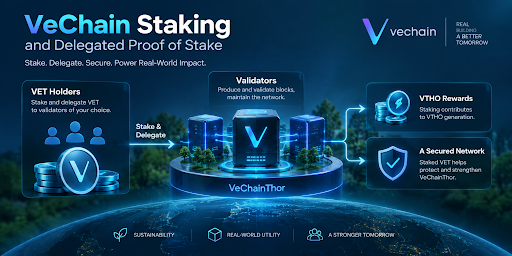
VeChainThor uses Delegated Proof of Stake, or DPoS, to secure the blockchain and determine participation in block validation. The model gives VET a direct role in network security.
How VeChain DPoS Works
Validators operate the infrastructure responsible for producing and validating blocks. Other VET holders can participate as delegators by assigning their stake to validators instead of operating validator infrastructure themselves. This creates two main roles within the consensus model. Validators perform the technical work required to maintain the blockchain, while delegators commit VET to validators they choose to support. Staked VET therefore contributes directly to the network's security and reward system.
VET Staking Through StarGate
StarGate provides infrastructure for participating in VeChain staking. VET holders can stake their assets and delegate them to validators without running a validator themselves. The staking system is also connected to VTHO generation. This differs from the historical VeChain model, where holding VET itself generated VTHO. Under the newer model, active staking is central to VTHO issuance and rewards.
VeChain Tokenomics, VTHO Fees and Supply
VeChain tokenomics combines a finite VET supply with VTHO as the operational token of VeChainThor. The maximum supply of VET is approximately 86.7 billion coins, while VTHO follows a different model because it is required to pay for network activity. VTHO issuance is connected to staked VET, while transaction activity consumes VTHO. Under the updated fee model, the base transaction fee paid in VTHO is burned, removing those tokens from circulation. The two assets therefore have distinct economic functions. VET provides the stake used within the network's security model, while VTHO pays for transactions and smart contract execution. Staking contributes to VTHO issuance, while blockchain activity consumes and burns VTHO.
VeChain Use Cases and Real-World Applications
VeChain was originally associated primarily with supply chain management, but its ecosystem has expanded into a broader range of real-world blockchain applications. VeChainThor can provide a verification layer for data connected with products, business processes, sustainability initiatives, and consumer services.
Supply Chain and Product Traceability
Supply chain management remains one of the best-known VeChain use cases. Physical products can be linked with digital records containing information collected during manufacturing, transportation, distribution, and sale. Depending on the application, QR codes, NFC technology, RFID tags, sensors, and other identification methods can connect physical items with blockchain data. This approach can support product provenance and authenticity checks. Luxury goods, food, automotive products, logistics, and manufacturing are among the sectors where VeChain technology has historically been explored. Blockchain cannot guarantee that source data is accurate, but it can provide a transparent and difficult-to-alter record after information has been entered.
Sustainability and Digital Product Data
VeChain has expanded into applications that connect sustainability activities and product information with verifiable digital records. Blockchain infrastructure can document selected information about materials, products, environmental activities, and other measurable events. Physical items can also be connected with digital identities containing information about their origin, characteristics, or lifecycle. This concept is relevant to digital product passports and other systems where information may need to remain accessible across different stages of a product's life.
VeBetterDAO and Consumer Applications
VeBetterDAO represents VeChain's expansion into consumer-facing applications. Its ecosystem is designed around applications that encourage users to record activities associated with sustainability and other positive behaviours, with blockchain providing infrastructure for verifying activities and distributing incentives. This extends VeChain beyond its traditional enterprise positioning. VeChainThor can support both business infrastructure and applications that consumers interact with directly.
VeChain ToolChain and the VeChain Ecosystem
VeChain has developed infrastructure intended to make blockchain easier to integrate into existing applications and business processes. This allows organisations to use VeChainThor without necessarily developing every blockchain component independently.
VeChain ToolChain
VeChain ToolChain was developed as a blockchain-as-a-service platform for businesses. It provides tools for integrating VeChainThor into solutions involving product tracking, data management, digital identities, and other business processes. ToolChain has played an important role in VeChain's enterprise development. However, the wider VeChain ecosystem now extends beyond enterprise applications to include Web3, sustainability, and consumer-focused services.
VeWorld and VeChain Applications
VeWorld is a wallet for interacting with the VeChain ecosystem. It enables users to manage supported VeChain assets and connect with decentralised applications running on VeChainThor. The wider ecosystem includes wallets, decentralised applications, developer tools, staking infrastructure, and consumer services. Together, these components expand the role of VeChainThor beyond its original supply chain focus.
What Makes VeChain Cryptocurrency Unique?
VeChain competes with numerous Layer 1 blockchains that process transactions and support smart contracts. Its main differences come from the combination of its two-token economy, specialised transaction features, and focus on real-world applications. Key VeChain features include:
- a dual-token system separating VET from the VTHO used for transaction fees;
- fee delegation that allows another party to cover a user's transaction costs;
- multi-clause transactions that combine several actions into one transaction;
- Delegated Proof of Stake with VET staking and delegation;
- EVM compatibility for smart contract development;
- infrastructure focused on real-world business and consumer applications.
These features can reduce some of the complexity involved in using blockchain applications. Fee delegation can remove the need for users to manage VTHO directly, while multi-clause transactions can simplify processes involving several related on-chain actions.
VeChain Advantages and Limitations
VeChain combines features designed for real-world blockchain adoption with some of the same limitations faced by other Layer 1 networks. Its suitability therefore depends on the application and the requirements of its users or developers.
Advantages of VeChain
The separation of VET and VTHO allows the primary network asset and transaction costs to perform different functions. Fee delegation can further simplify applications by allowing businesses or service providers to cover transaction costs for users. VeChainThor also offers smart contracts, EVM compatibility, multi-clause transactions, staking, and infrastructure for connecting blockchain records with real-world data. These capabilities support both enterprise and consumer applications.
Limitations of VeChain
The dual-token model introduces additional complexity because users need to understand the different roles of VET and VTHO. Developers must also decide how transaction fees and fee delegation should be handled within their applications. VeChain operates in a competitive Layer 1 market where networks compete for developers, users, and adoption. VET is also a market-traded cryptocurrency, so its price can fluctuate independently of the technical utility of VeChainThor.
How to Store and Transfer VET Cryptocurrency
VET can be stored in wallets that support the native VeChainThor network. Users should verify network compatibility before making a transfer and distinguish native VET from wrapped or bridged assets that may exist on other networks.
VET Wallets
VeWorld is one of the main wallets developed for the VeChain ecosystem. It supports VeChain assets and provides access to decentralised applications and other network functions. Other compatible wallets may also support native VET. With a self-custody wallet, control of the recovery phrase or private keys means control of the assets. This information should be stored securely and never shared with third parties.
Sending VET on VeChainThor
Before sending VET, users should verify the recipient address and confirm that both services support VeChainThor. A small test transaction can also help reduce risk when transferring a large amount. On-chain operations require VTHO for network costs, although fee delegation may allow another party to pay these fees in supported applications. Users should always check the network and applicable withdrawal requirements before confirming a transfer.
Conclusion
VeChain has evolved from a blockchain focused largely on supply chain management into a broader Layer 1 ecosystem for real-world applications. VeChainThor supports smart contracts, EVM-compatible development, staking, specialised transaction features, and applications that connect blockchain records with physical products and external data. Its two-token architecture remains central to the network. VET serves as the primary cryptocurrency and staking asset, while VTHO pays for transactions and smart contract execution. The transition to Delegated Proof of Stake has also given active VET staking a more direct role in network security and VTHO issuance. Beyond blockchain-specific applications, cryptocurrencies are increasingly used for practical online spending. Services such as Baxity Store provide another connection between digital assets and everyday use by offering gift cards, prepaid solutions, gaming products, and other digital goods through supported cryptocurrency payment methods.
FAQ About VeChain (VET) and the VeChainThor Network
Can VeChain Be Used Without Holding VTHO?
In some cases, yes. VeChainThor supports fee delegation, which allows a third party, such as an application or service provider, to pay transaction fees on behalf of the user. This can make blockchain applications easier to use because the customer does not always need to obtain VTHO before completing an action. Whether fee delegation is available depends on how a particular application has been designed. Users interacting directly with the network may still need VTHO to cover gas costs. It is therefore important to check the requirements of the wallet, exchange, or application being used.
Is VET the Same as an ERC-20 Token?
No, native VET is not an ERC-20 token. VeChain originally used the VEN token on Ethereum before launching its own VeChainThor mainnet in 2018. After the migration, VEN was replaced by native VET on VeChainThor. Wrapped or bridged versions of VET may exist on other blockchains, but they are not the same as native VET held directly on VeChainThor. This distinction matters when transferring funds between wallets and exchanges because the correct network must be selected. Users should always verify whether a platform supports native VeChainThor VET before making a deposit or withdrawal.
Can VeChain Support NFTs and Tokenised Assets?
Yes, VeChainThor can support non-fungible tokens and other forms of tokenised assets through smart contracts. These tokens can represent digital collectibles, certificates, product identities, access rights, or links to physical assets. Because VeChain has historically focused on real-world data, tokenisation can also be used to connect physical products with digital records. The practical value depends on the application and on how accurately the underlying real-world information is verified. Ownership of an on-chain token does not automatically guarantee legal ownership of a corresponding physical asset unless the relevant legal and contractual framework provides for it. Developers therefore need to consider both the technical and off-chain aspects of tokenisation.
What Happens if a VeChain Transaction Is Sent to the Wrong Address?
Blockchain transactions are generally irreversible after they have been confirmed. If VET is sent to an incorrect VeChainThor address, there is no central authority that can simply cancel the transaction or recover the funds. Recovery may only be possible if the sender knows and can contact the owner of the destination address. Sending assets to an incompatible platform or unsupported deposit address can create additional recovery problems. Exchanges may sometimes offer recovery services for certain mistakes, but this is not guaranteed and may involve a fee. Checking the full address, network, and deposit instructions before confirming a transfer remains the safest approach.
Can VeChainThor Applications Hide Blockchain Complexity From Users?
Yes, VeChainThor includes features that can help developers create applications where blockchain mechanics are less visible to the end user. Fee delegation is one example because an application can cover VTHO transaction costs instead of requiring users to manage gas themselves. Multi-clause transactions can also reduce the number of separate blockchain actions needed for some processes. This can make an application feel more similar to a conventional web or mobile service. However, the exact user experience depends on how developers implement wallets, authentication, transaction signing, and fee management. Blockchain infrastructure may therefore operate largely in the background without disappearing completely.
What Should Users Check Before Withdrawing VET From an Exchange?
The first step is to confirm that the receiving wallet supports native VET on the VeChainThor network. Users should also check the withdrawal network shown by the exchange because selecting a different blockchain may result in funds being sent in an incompatible form. The destination address should be copied carefully and compared before the withdrawal is confirmed. It is also useful to review the exchange's minimum withdrawal amount and withdrawal fee. For a large transfer, sending a smaller test amount first can reduce the risk of an expensive mistake. Users should additionally make sure they control the recovery phrase or private keys if they are withdrawing to a self-custody wallet.
Comments
Sign in to join the conversation. Every comment is reviewed before it appears on the page.
Sign in to comment
You need an account to leave a comment. Sign in and your name will be used automatically.
No comments yet. Be the first to write one.