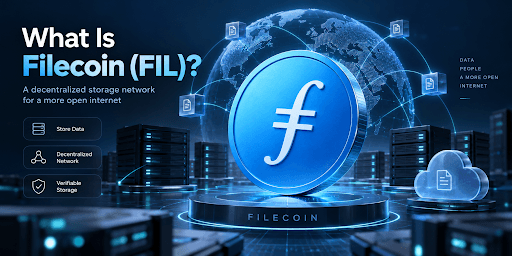
Filecoin is a decentralised storage network that creates an open marketplace for storing digital data. Instead of relying entirely on infrastructure controlled by a single cloud company, Filecoin allows independent storage providers to contribute capacity and receive compensation. Blockchain technology and cryptographic proofs help verify that providers actually store the data they have committed to keep.FIL is the native cryptocurrency of the Filecoin network. It is used for payments, provider rewards, transaction fees and collateral. This combination of blockchain infrastructure, physical storage resources and economic incentives distinguishes Filecoin from cryptocurrencies designed mainly for payments or value transfer.
Using Cryptocurrency for Digital Purchases at Baxity Store
Baxity Store provides a practical way to use supported cryptocurrencies for everyday digital purchases. Instead of limiting digital assets to trading, investing, or blockchain applications, customers can use available crypto payment methods to purchase products such as gift cards, prepaid payment solutions, gaming products, and other digital goods. This creates a familiar way to turn cryptocurrency into purchasing power for online shopping, entertainment, subscriptions, and digital services. Baxity Store also offers crypto-related cards and vouchers connected to popular digital platforms and payment ecosystems. Depending on the product, these options can provide access to online services, gaming balances, subscriptions, and other digital purchases. With support for multiple cryptocurrency payment methods and fast delivery of digital codes, Baxity Store helps bridge the gap between cryptocurrency ownership and practical online spending without requiring users to navigate complex blockchain applications.
What Is Filecoin (FIL) and What Is It Used For?
Filecoin is a blockchain-based decentralised storage network developed within the ecosystem created by Protocol Labs. Its mainnet launched in October 2020. The project's central idea is to create a marketplace where users who need storage can connect with independent providers offering storage capacity. Unlike conventional cloud storage, Filecoin does not depend on a single company controlling all participating infrastructure. Storage providers operate their own hardware, while the Filecoin blockchain coordinates network activity and verifies storage commitments. FIL cryptocurrency provides the economic layer connecting clients and providers.
The Purpose of the Filecoin Network
Filecoin does not store ordinary files directly inside blockchain blocks. Instead, providers keep the data on physical storage infrastructure, while the blockchain records relevant operations and verifies cryptographic evidence that storage commitments are being fulfilled. This model creates a market for storage capacity. Providers contribute resources and clients purchase storage according to available terms. Pricing and other conditions can vary between providers rather than being established by one central cloud operator.
What Is Filecoin Used For?
Filecoin use cases generally involve data that benefits from distributed and verifiable storage. The network can support Web3 applications, digital archives, public datasets, application data and other types of content requiring long-term storage. Filecoin is not a direct replacement for every conventional cloud platform. Traditional providers often combine storage with computing, databases, content delivery and numerous managed services. Filecoin focuses primarily on an open infrastructure for verifiable data storage that can work alongside other technologies.
How Does Filecoin Work?
Understanding how Filecoin works requires separating the blockchain from the physical storage itself. Storage providers supply capacity, clients need data stored, and the protocol coordinates these relationships while verifying that providers fulfil their commitments. Data is stored on hardware operated by providers rather than directly on the blockchain. Providers organise storage into structures called sectors and submit cryptographic proofs demonstrating that the required storage resources have been committed and maintained.
Filecoin Storage Providers and Clients
Filecoin storage providers operate the hardware required to store data. They prepare storage sectors, maintain Filecoin-compatible infrastructure and submit proofs required by the protocol. Clients represent the demand side of the Filecoin storage marketplace. They can select storage services and arrange for data to be stored by providers. Applications and services built on Filecoin can also handle much of the technical complexity, allowing users to access the network without interacting directly with low-level protocol functions.
Filecoin Storage Deals
Filecoin storage deals define arrangements under which data is stored for an agreed period. The process can be summarised as follows:
- A client prepares data and identifies suitable storage capacity.
- Storage terms are established with a provider.
- The data is transferred to the provider.
- The provider prepares it for Filecoin storage and places it in a sector.
- Cryptographic proofs verify that storage resources have been committed.
- The provider continues proving storage throughout the required period.
Payments, collateral and penalties provide economic incentives for providers to follow network rules. This combination of physical storage, cryptographic verification and economic incentives distinguishes Filecoin storage from a simple peer-to-peer file transfer system.
How Data Retrieval Works
Storage and retrieval are related but separate processes. The blockchain does not operate like a conventional web server that sends an entire file whenever it is requested. Retrieval depends on providers and supporting infrastructure used to deliver stored content. Performance can therefore vary according to provider infrastructure, connectivity and the retrieval method. Filecoin's main innovation is not guaranteed faster downloads, but a decentralised storage market where commitments can be independently verified.
Filecoin Proof of Replication and Proof of Spacetime
Cryptographic storage proofs allow the Filecoin blockchain to verify that providers are contributing real storage resources. Two mechanisms are particularly important: Proof-of-Replication and Proof-of-Spacetime. Proof-of-Replication verifies the initial storage commitment, while Proof-of-Spacetime demonstrates that the required data continues to be stored over time. Together, they form the basis of Filecoin's verifiable storage model.
What Is Proof of Replication?
Filecoin Proof of Replication, or PoRep, provides cryptographic evidence that a storage provider has created a unique encoded replica of data and dedicated storage capacity to it. This prevents providers from simply claiming storage resources without demonstrating that the corresponding capacity has actually been allocated. PoRep is generated during the process of preparing and sealing a Filecoin sector. The network can verify the resulting proof rather than relying solely on the provider's statement that the data has been stored.
What Is Proof of Spacetime?
Proof of Spacetime, or PoSt, demonstrates that a provider continues to maintain committed storage after the initial proof. This is necessary because proving that data existed at one point does not demonstrate that it remained stored for the required period. WindowPoSt requires providers to demonstrate that committed sectors remain available during recurring proving periods. Filecoin Proof of Spacetime therefore makes storage verification an ongoing responsibility rather than a one-time check.
Why Filecoin Storage Proofs Matter
Proofs reduce the need to trust a storage provider's claims. Filecoin also combines technical verification with economic incentives, including collateral and penalties for failing to satisfy relevant network obligations.
| Filecoin mechanism | What it demonstrates | Purpose |
|---|---|---|
| Proof-of-Replication | A unique encoded replica has been created | Verifies the initial storage commitment |
| Proof-of-Spacetime | Committed storage continues to be maintained | Verifies storage over time |
| WindowPoSt | Sectors remain available during recurring proving periods | Provides ongoing verification |
These mechanisms explain why Filecoin is more accurately described as a verifiable decentralised storage network than as a blockchain where files are simply uploaded and stored.
What Is FIL Token and What Is FIL Used For?
FIL is the native cryptocurrency of Filecoin and provides the economic layer connecting clients, storage providers and blockchain operations. FIL token utility is closely tied to the storage network rather than existing solely for trading or transfers between wallets. FIL is involved in storage-related payments, provider incentives, collateral and transaction fees. It can also be used within applications and smart contracts operating in the Filecoin ecosystem.
FIL Token Utility
The main functions of FIL include:
- paying for storage-related services within the Filecoin economy;
- rewarding storage providers for contributing resources and supporting the network;
- serving as collateral for provider commitments;
- paying transaction fees on the Filecoin blockchain;
- supporting transactions and applications built using the Filecoin Virtual Machine.
Collateral is particularly important because it gives storage providers a financial incentive to fulfil their commitments. Failure to meet applicable network obligations can result in economic penalties.
Filecoin Tokenomics
Filecoin tokenomics are designed around the operation of a decentralised storage network. FIL can enter circulation through mechanisms such as network rewards, while tokens can also be locked as collateral or spent on transaction fees. This gives FIL cryptocurrency protocol-level utility in addition to its market value. Its role in payments, incentives and collateral connects the token economy directly with the storage resources contributed to the Filecoin network.
Filecoin vs IPFS: What Is the Difference?
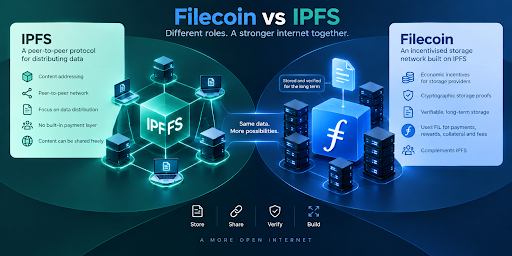
Filecoin and IPFS are closely related technologies, but they solve different problems. IPFS, or the InterPlanetary File System, is a peer-to-peer protocol for storing, addressing and transferring data using content-based identifiers. Instead of locating content primarily by the server where it is hosted, IPFS identifies data by what it contains. Filecoin adds an economic and verification layer for persistent storage. Storage providers can receive compensation for committing capacity, while cryptographic proofs demonstrate that storage obligations are being maintained. Understanding this distinction is important because IPFS and Filecoin can complement each other, but they are not interchangeable systems.
How IPFS Works
IPFS uses content addressing, which means that data is identified through a cryptographic identifier derived from its content. Users can retrieve content from network participants that have the requested data available. This approach differs from the traditional location-based model used by much of the web. However, making content available through IPFS does not by itself create a paid agreement requiring an independent provider to keep that content for a specified period. Persistent availability requires someone to continue hosting or pinning the data.
How Filecoin Extends the IPFS Model
The main difference between Filecoin and IPFS is the economic mechanism surrounding storage. Filecoin creates a marketplace in which providers commit resources to storing data and can receive FIL in return. Storage proofs provide additional verification that these commitments are being maintained. In practical terms, the differences include:
- IPFS focuses on content addressing and peer-to-peer data distribution, while Filecoin provides an incentivised storage network.
- Filecoin uses FIL to support payments, rewards, collateral and transaction fees.
- Filecoin storage commitments can be verified through Proof-of-Replication and Proof-of-Spacetime.
- IPFS can distribute content without requiring a Filecoin storage deal.
- Filecoin and IPFS can be used together as complementary technologies.
The Filecoin vs IPFS comparison is therefore not about choosing two competing versions of the same product. IPFS provides technology for addressing and moving content, while Filecoin introduces a blockchain-based market for verifiable storage.
Filecoin Virtual Machine and Filecoin Smart Contracts
Filecoin has expanded beyond its original role as a decentralised storage marketplace. The Filecoin Virtual Machine, commonly known as FVM, adds programmable smart contract functionality to the network. This allows developers to build applications that combine blockchain logic with Filecoin's storage infrastructure. The FVM launched on the Filecoin mainnet in March 2023. It introduced user-programmable smart contracts while retaining Filecoin's existing storage capabilities, opening the network to applications that can automate interactions involving data, FIL and other blockchain operations.
What Is Filecoin Virtual Machine?
The Filecoin Virtual Machine is the execution environment for smart contracts on Filecoin. It allows programmable logic to operate on the network instead of limiting blockchain activity to predefined storage and token operations. FVM also supports compatibility with the Ethereum ecosystem through the Filecoin Ethereum Virtual Machine, or FEVM. This enables developers to deploy EVM-compatible smart contracts and use familiar Ethereum development tools while interacting with the Filecoin ecosystem.
Filecoin Smart Contracts and Applications
Filecoin smart contracts can automate processes that previously required external coordination. Applications can use programmable rules to interact with storage services, manage payments and create new services around data. Potential applications include automated storage arrangements, data DAOs, decentralised finance connected to FIL and applications that coordinate access to datasets. FVM also provides a foundation for developing services in which storage becomes part of a broader programmable workflow rather than an isolated operation.
Filecoin vs Cloud Storage: Benefits and Limitations
Filecoin vs cloud storage is primarily a comparison between different infrastructure and economic models. Traditional cloud platforms generally operate through centrally managed networks of data centres. Filecoin distributes storage commitments among independent providers participating in an open marketplace. This does not mean that Filecoin is automatically a better choice than conventional cloud storage. The appropriate model depends on factors such as performance requirements, accessibility, integration, data management needs and the level of technical complexity an organisation can support.
Filecoin vs Traditional Cloud Storage
Centralised cloud services usually provide predictable interfaces and extensive ecosystems that may include computing, databases, analytics and content delivery. Filecoin concentrates on decentralised and verifiable storage, with blockchain mechanisms used to coordinate providers and validate their commitments. Another difference concerns trust. Customers of conventional cloud platforms rely largely on the provider's infrastructure and contractual commitments. Filecoin introduces cryptographic storage proofs that allow the network to verify specific storage obligations. At the same time, traditional cloud services may offer simpler integration and performance characteristics better suited to applications requiring rapid and frequent access to data.
Filecoin Benefits
The main Filecoin benefits arise from its combination of decentralised infrastructure, cryptographic verification and economic incentives. Depending on the use case, advantages can include:
- access to an open marketplace of independent storage providers;
- cryptographic verification of storage commitments;
- economic incentives for providers to maintain allocated storage;
- reduced dependence on a single infrastructure operator;
- integration with Web3 applications and blockchain-based services;
- programmable functionality through the Filecoin Virtual Machine.
These characteristics can be particularly relevant for applications that value verifiable or distributed long-term storage. They do not guarantee that Filecoin will be cheaper, faster or more suitable than centralised alternatives in every situation.
Filecoin Limitations and Risks
Filecoin also introduces additional complexity. Direct interaction with blockchain infrastructure, wallets, FIL and storage mechanisms can require more technical knowledge than using a conventional consumer cloud service. Applications built on Filecoin may therefore use additional software layers to simplify the experience. Retrieval performance can depend on provider infrastructure and the method used to access data. FIL price volatility is another consideration when cryptocurrency is involved in network operations. Users must also manage the usual blockchain risks, including wallet security, private key protection and sending assets through the correct network.
How to Buy, Store and Use Filecoin (FIL)
FIL cryptocurrency is available through various cryptocurrency services, and its practical use extends beyond simply holding the asset. Users may acquire FIL for network transactions, applications or other supported purposes. The exact availability, fees and supported networks depend on the platform being used. Anyone transferring FIL should verify wallet compatibility and transaction details before sending funds. Blockchain transactions are generally irreversible, so an incorrect address or unsupported network can result in a permanent loss of assets.
How to Buy FIL
One common way to buy Filecoin is through a cryptocurrency exchange that lists FIL. Users typically create an account where required, select an available trading pair or payment method, purchase FIL and decide whether to keep it with the service or transfer it to another wallet. Fees, payment methods and withdrawal requirements differ between exchanges. Users should therefore check current conditions directly with their chosen platform rather than assuming that every service offers the same FIL purchasing or withdrawal options.
How to Store Filecoin
A Filecoin wallet allows users to control an address that can hold and transfer FIL. Storage options include custodial services, where a third party controls the private keys, and self-custody wallets, where the user is responsible for protecting the credentials required to access the funds. Self-custody provides greater direct control but also places responsibility for security on the owner. Seed phrases and private keys should be protected from unauthorised access, and wallet compatibility should be confirmed before receiving FIL.
How to Use FIL
How to use FIL depends on the service or application involved. Within the Filecoin ecosystem, FIL supports transaction fees, provider collateral, storage-related economic activity and smart contract interactions. It can also be transferred between compatible Filecoin addresses. FIL may also be supported by third-party cryptocurrency services outside the Filecoin ecosystem. Availability can change over time, so users should confirm that a particular platform supports FIL before attempting to make a payment, deposit or withdrawal.
Filecoin Cryptocurrency: Key Takeaways
Filecoin cryptocurrency is part of a blockchain ecosystem built around a specific resource: digital storage. Instead of using blockchain technology to store ordinary files directly, the Filecoin network coordinates independent storage providers and uses Proof-of-Replication and Proof-of-Spacetime to verify their commitments. FIL provides the economic foundation for this system through payments, rewards, transaction fees and collateral. The relationship between Filecoin and IPFS, together with the introduction of the Filecoin Virtual Machine, has also expanded the project's role within decentralised infrastructure. Filecoin now combines verifiable storage with programmable smart contracts and a broader ecosystem of data-focused applications. For users, FIL can therefore function both as a cryptocurrency and as an asset with specific utility within a decentralised storage network.
Filecoin (FIL) FAQ
What Is the Maximum Supply of Filecoin (FIL)?
Filecoin has a maximum supply of 2 billion FIL, but this does not mean that all tokens are available on the market at the same time. The supply enters circulation through different mechanisms, including mining rewards, ecosystem allocations and previously established vesting schedules. Some FIL is also locked as collateral by storage providers, reducing the amount that can circulate freely at a given moment. In addition, part of the FIL used for network fees can be permanently removed from circulation through burning mechanisms. As a result, the circulating supply changes over time and should not be confused with the protocol's maximum supply. Users comparing Filecoin tokenomics should therefore check current circulating supply data rather than relying only on the 2 billion FIL limit.
Can Anyone Become a Filecoin Storage Provider?
Filecoin is an open network, but becoming a storage provider requires substantially more than installing a wallet and connecting spare disk space. Providers need suitable storage hardware, reliable connectivity, computing resources and enough operational capacity to submit required proofs on time. They must also manage FIL collateral and maintain infrastructure continuously to avoid penalties associated with missed obligations. Hardware and operational requirements can make professional participation capital intensive, especially for providers operating at meaningful scale. This means Filecoin storage provision is closer to running specialised infrastructure than participating in simple consumer cryptocurrency mining. Prospective providers should review current protocol and hardware requirements before investing in equipment.
Is Data Stored on Filecoin Permanently?
Filecoin does not automatically guarantee that every file will remain stored forever. Storage arrangements are generally associated with specific periods, and continued preservation depends on renewing or replacing those arrangements when necessary. Applications can automate parts of this process, but long-term availability still requires active storage management. Important data may also be stored with multiple providers to reduce dependence on any single copy or operator. For archival use cases, redundancy and renewal policies can therefore be as important as the original storage transaction. Users should distinguish between verifiable storage for a defined period and permanent preservation with no ongoing management.
Is Filecoin Storage Private or Encrypted?
Filecoin's storage proofs verify that data is being stored, but they do not automatically make the underlying content private. Privacy depends on how the data is prepared and encrypted before it is sent to a storage provider. Sensitive information should generally be encrypted at the application or user level so that a provider cannot read the original content. Access control can also be implemented through software built on top of the Filecoin ecosystem. This distinction is important because verifiability and confidentiality solve different problems. A file can be cryptographically proven to exist in storage while still requiring separate encryption to protect its contents.
What Happens If a Filecoin Storage Provider Goes Offline?
Temporary or prolonged provider outages can affect the ability to access stored data and may also create consequences for the provider under Filecoin's proof system. Providers are expected to submit required proofs and maintain their committed sectors according to protocol rules. Repeated failure to satisfy these obligations can lead to financial penalties and loss of associated rewards or collateral. For users, the practical risk can be reduced by maintaining multiple copies of important data across different providers or storage systems. Applications built on Filecoin may also manage replication and provider selection automatically. Users storing critical information should therefore consider redundancy rather than relying on one provider as the only available copy.
Does Filecoin Use a Lot of Energy?
Filecoin's resource requirements differ from those of Proof of Work blockchains such as Bitcoin. Storage providers consume electricity for storage devices, servers, networking and the computation needed to create and verify storage proofs. The amount of energy used depends on factors such as provider scale, hardware efficiency and utilisation of the stored capacity. Filecoin's model is based on proving useful storage resources rather than performing continuous competitive hashing solely to win blocks. However, decentralised storage infrastructure still has an environmental footprint and should not be described as energy free. Evaluating Filecoin's sustainability therefore requires considering both its computing requirements and the practical utilisation of the storage hardware supporting the network.
Can Filecoin Be Used Without Holding FIL?
End users do not always need to interact directly with FIL to use services built on Filecoin. Some applications abstract blockchain payments and technical operations behind conventional interfaces, meaning users may pay through another method or interact with a service without managing a Filecoin wallet themselves. Behind the scenes, the application or infrastructure provider can handle the FIL required for network operations. Direct protocol participation, however, generally involves FIL for fees, collateral or other network functions. This distinction makes Filecoin accessible through both blockchain-native tools and more familiar application interfaces. Users should check how a particular Filecoin-based service handles payments before assuming that FIL ownership is required.




Comments
Sign in to join the conversation. Every comment is reviewed before it appears on the page.
Sign in to comment
You need an account to leave a comment. Sign in and your name will be used automatically.
No comments yet. Be the first to write one.