As the blockchain industry has grown, hundreds of independent networks have emerged to support cryptocurrencies, decentralized finance (DeFi), gaming, tokenized assets, and enterprise applications. While each blockchain offers unique features, most were originally designed to operate in isolation. Assets, smart contracts, and data often remain confined to their native ecosystems, making communication between different networks slow, expensive, or dependent on third-party bridges.
Cosmos was created to solve this challenge by introducing a framework that allows independent blockchains to communicate with one another without sacrificing their sovereignty. Rather than building a single blockchain that hosts every application, Cosmos enables developers to create specialized blockchains while providing standardized methods for transferring assets and data between them. This vision has earned Cosmos the nickname “the Internet of Blockchains.”
ATOM is the native cryptocurrency of Cosmos Hub, the first blockchain launched within the Cosmos ecosystem. It is primarily used for staking, governance, network security, and transaction fees on Cosmos Hub. Although many blockchain projects are built using Cosmos technologies, ATOM is not the universal currency of every network in the ecosystem.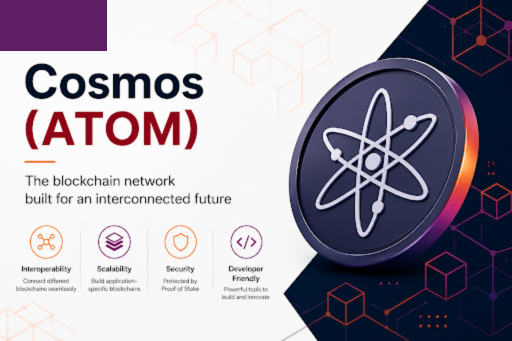
Using Cryptocurrency for Digital Purchases at Baxity Store
Cryptocurrencies have evolved beyond investment and trading, becoming a practical payment method for a growing number of digital products and online services. Instead of converting digital assets into traditional currency before making a purchase, many users now prefer platforms that allow them to spend cryptocurrency directly on products they can use immediately. This approach makes everyday online shopping more convenient while reducing the number of steps required to complete a transaction.
Baxity Store is a digital marketplace designed to simplify this experience. The platform enables customers to purchase a wide variety of digital products, including gift cards, prepaid payment solutions, gaming credits, and cryptocurrency-related vouchers using supported cryptocurrency payment methods. After a successful purchase, digital codes are delivered instantly, allowing users to activate services, top up accounts, or redeem products within minutes.
In addition to gift cards and gaming products, Baxity Store offers prepaid cards and crypto-related vouchers connected to well-known digital platforms and payment ecosystems. These products provide an additional way to convert cryptocurrency into practical purchasing power for subscriptions, entertainment services, online shopping, and other digital transactions. By combining secure cryptocurrency payments with fast digital delivery, Baxity Store helps make digital assets more useful for everyday online spending.
What Is Cosmos?
Cosmos is a decentralized blockchain ecosystem designed to improve interoperability between independent blockchain networks. Instead of creating one blockchain capable of handling every application, Cosmos provides the tools needed to build many specialized blockchains that can communicate securely with each other.
Each blockchain built with Cosmos technologies can maintain its own validators, governance model, tokenomics, transaction fees, and execution environment. At the same time, compatible chains can exchange assets and information through standardized communication protocols without relying on centralized intermediaries.
The primary goals of Cosmos include:
- Enabling interoperability between independent blockchains.
- Simplifying blockchain development through reusable infrastructure.
- Improving scalability by allowing applications to run on dedicated blockchains.
- Supporting secure cross-chain asset and data transfers.
- Giving developers complete control over their own blockchain architecture.
It is also important to distinguish several closely related terms that are often confused.
| Term | Description |
|---|---|
| Cosmos | The overall ecosystem of technologies, standards, and interconnected blockchain networks. |
| Cosmos Hub | The first public blockchain launched within the Cosmos ecosystem. It uses ATOM as its native cryptocurrency. |
| ATOM | The native token of Cosmos Hub used for staking, governance, transaction fees, and network security. |
| Interchain | The broader vision and infrastructure that enables communication between multiple sovereign blockchains. |
Unlike many blockchain platforms, Cosmos does not require every application to compete for resources on the same network. Instead, projects can launch their own application-specific blockchains while still benefiting from interoperability with the wider ecosystem.
Who Created Cosmos?
The idea behind Cosmos originated from the work of developers seeking a more scalable and interconnected blockchain ecosystem. One of the key technologies that made this vision possible was Tendermint, a Byzantine Fault Tolerant consensus engine created by software developer Jae Kwon. Tendermint demonstrated that secure Proof of Stake blockchains could be built more efficiently by separating the consensus layer from the application layer.
To support the long-term development of the project, the Interchain Foundation (ICF) was established as a Swiss nonprofit organization. The foundation funds research, ecosystem development, grants, and open-source software that contributes to the growth of the Cosmos ecosystem.
Development of the core infrastructure has involved several organizations over the years, including Tendermint Inc., which later became Ignite, and Informal Systems, a company focused on maintaining and improving many components of the Cosmos technology stack.
Several milestones shaped the evolution of Cosmos:
- The Cosmos white paper introduced the concept of an interconnected network of sovereign blockchains.
- A token sale held in 2017 raised funding for ecosystem development.
- Cosmos Hub launched in 2019 as the first blockchain built using the Cosmos architecture.
- The Inter-Blockchain Communication (IBC) protocol was activated in 2021, allowing compatible blockchains to exchange assets and data.
The ecosystem has continued expanding with dozens of production blockchains, infrastructure providers, decentralized applications, and modular blockchain solutions. Today, Cosmos has grown beyond a single blockchain into one of the largest ecosystems focused on blockchain interoperability and application-specific networks.
How Does Cosmos Work?
Unlike traditional blockchain ecosystems where every decentralized application operates on a shared network, Cosmos allows each project to launch its own blockchain while maintaining compatibility with other Cosmos-based chains.
This approach gives developers greater flexibility. Each blockchain can define its own consensus parameters, governance rules, token economy, transaction fees, and upgrade schedule without affecting the operation of other networks.
The Cosmos architecture is generally divided into three primary layers:
- The application layer contains the business logic of the blockchain. This includes smart contracts, token issuance, governance mechanisms, decentralized finance protocols, gaming applications, or any other functionality specific to the network.
- The consensus layer ensures that validators agree on the current state of the blockchain and produce new blocks securely. Cosmos relies on Byzantine Fault Tolerant Proof of Stake consensus to achieve fast transaction finality while maintaining network security.
- The networking layer enables communication between nodes within the blockchain and, through additional protocols, with other compatible blockchains.
Rather than requiring developers to build each of these components from scratch, Cosmos provides reusable infrastructure that significantly reduces development time while maintaining a high degree of customization.
What Is the Cosmos SDK?
The Cosmos SDK is an open-source framework that allows developers to build custom blockchains without implementing every core blockchain component themselves.
Instead of writing an entirely new blockchain from the ground up, developers assemble prebuilt modules that handle common blockchain functionality while adding their own application-specific logic where necessary.
The Cosmos SDK includes modules that support:
- Account management.
- Token issuance and transfers.
- Staking.
- Validator management.
- Governance.
- Transaction processing.
- Reward distribution.
- Protocol upgrades.
Its modular architecture allows developers to include only the components their blockchain requires. Additional modules can also be developed independently, making each blockchain highly customizable.
Many well-known blockchain networks have adopted the Cosmos SDK because it offers flexibility while maintaining compatibility with other Cosmos technologies.
What Is CometBFT and How Does Consensus Work?
One of the core technologies powering many Cosmos-based blockchains is CometBFT, the continuation of the software previously known as Tendermint Core.
CometBFT combines networking and consensus into a reusable engine that enables developers to focus primarily on application development rather than low-level blockchain infrastructure.
Most Cosmos SDK blockchains use a Proof of Stake consensus mechanism. Instead of miners competing to solve computational puzzles, validators are responsible for producing new blocks and verifying transactions.
The system includes several important participants:
- Validators, who operate network nodes and validate transactions.
- Delegators, who stake their tokens with validators without running their own infrastructure.
- Governance participants, who vote on protocol proposals.
- Network users, who pay transaction fees when interacting with the blockchain.
Validators are selected according to their voting power, which depends largely on the amount of tokens delegated to them. Honest participation allows validators and delegators to earn staking rewards. However, malicious behavior or extended downtime may result in slashing, which reduces part of the validator’s staked assets and, in some cases, the delegated tokens associated with that validator.
One of the major advantages of CometBFT is fast transaction finality. Once a block has been finalized, it cannot normally be reversed without compromising the network’s consensus assumptions. This provides greater certainty for users and applications compared to blockchain systems that rely on probabilistic finality.
What Is the Inter-Blockchain Communication Protocol?
One of the most important innovations introduced by Cosmos is the Inter-Blockchain Communication protocol, commonly known as IBC. This protocol enables independent blockchains to exchange tokens, messages, and other types of data without relying on centralized bridges or trusted intermediaries.
Rather than merging all blockchains into one network, IBC allows each blockchain to remain sovereign while establishing secure communication channels with other compatible chains. Every participating blockchain independently verifies the information it receives, helping reduce the trust assumptions often associated with traditional cross-chain bridges.
Several components work together to enable IBC communication:
- Clients verify the state of another blockchain.
- Connections establish a trusted relationship between two chains.
- Channels provide dedicated communication paths for specific applications.
- Relayers transmit messages between blockchains without controlling user assets.
- Packets carry tokens, data, or application messages across the network.
One common misconception is that all IBC transfers pass through Cosmos Hub. In reality, compatible blockchains can establish direct IBC connections with one another, allowing assets and information to move across the ecosystem without requiring Cosmos Hub to act as an intermediary.
Cosmos Hub, Zones, and Hubs Explained
The original Cosmos architecture introduced the concepts of hubs and zones to organize blockchain interoperability.
A zone is an independent blockchain that operates with its own validators, governance system, token economy, and applications. Each zone remains fully sovereign and can continue operating even if other blockchains experience technical issues.
A hub is a blockchain designed to facilitate communication between multiple zones. Although hubs can simplify routing and connectivity, they do not control the blockchains connected to them.
Cosmos Hub is the first blockchain launched within the Cosmos ecosystem and remains one of its most recognized networks. Its primary responsibilities include maintaining the ATOM token, supporting governance, participating in Interchain Security services, and connecting with numerous IBC-enabled blockchains.
It is important to understand that Cosmos Hub does not function as a central authority. Many blockchain networks communicate directly with one another through IBC without depending on Cosmos Hub for every transaction or message.
What Is Interchain Security?
Launching a new blockchain usually requires building a reliable validator network capable of securing the chain against attacks. For smaller projects, attracting enough validators can be challenging during the early stages of development.
Interchain Security was introduced to help address this problem. Under this model, certain blockchains known as consumer chains can leverage the economic security provided by validators participating in Cosmos Hub.
Instead of maintaining a completely independent validator set from the beginning, a consumer chain can rely on validators that already secure Cosmos Hub. This approach allows developers to focus more on application development while benefiting from an established security infrastructure.
Potential advantages of Interchain Security include:
- Reduced barriers for launching new blockchains.
- Stronger economic security during the early stages of network growth.
- Additional reward opportunities for participating validators.
- Improved efficiency for specialized blockchain development.
Although this model provides meaningful benefits, it also introduces additional technical and economic considerations. Projects must carefully evaluate whether shared security aligns with their governance model, operational requirements, and long-term goals.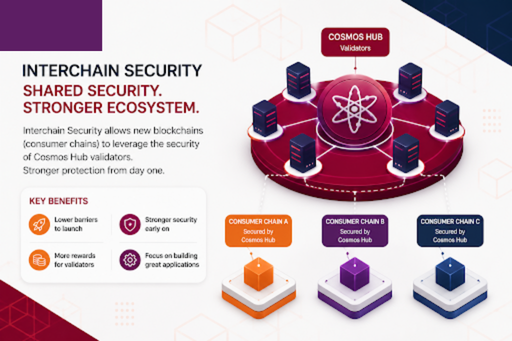
What Is the ATOM Token?
ATOM is the native cryptocurrency of Cosmos Hub. While many blockchain projects use Cosmos technologies, they often issue their own native tokens rather than relying on ATOM for network operations.
Within Cosmos Hub, ATOM performs several important functions. It is used to pay transaction fees submitted to the network. Token holders can stake or delegate ATOM to validators, helping secure the blockchain while earning staking rewards. Staked ATOM also provides voting power that allows holders to participate in governance decisions affecting the future development of Cosmos Hub.
Unlike some blockchain ecosystems where a single token powers every application, Cosmos follows a more decentralized approach. Individual blockchains remain free to design their own economic models while maintaining interoperability with other networks.
How Does ATOM Staking Work?
Proof of Stake is one of the core mechanisms securing Cosmos Hub. Rather than purchasing expensive mining hardware, users participate by staking ATOM tokens.
Most token holders choose delegation instead of operating their own validator infrastructure. Delegators assign their voting power to trusted validators while retaining ownership of their tokens. Validators produce blocks, validate transactions, and receive rewards that are shared with delegators after deducting validator commissions.
Several concepts are important when understanding ATOM staking:
- Bonded ATOM refers to tokens actively securing the network.
- Staking rewards vary depending on network parameters and validator performance.
- Validator commissions determine the percentage retained by validators before distributing rewards.
- Unbonding periods delay withdrawals after staking is cancelled.
- Slashing may reduce staked assets if validators behave maliciously or remain offline for extended periods.
Although staking can generate additional ATOM, rewards are never guaranteed. Market volatility, validator performance, inflation, and governance decisions can all influence long-term returns.
ATOM Tokenomics and Supply
ATOM uses a dynamic monetary policy rather than a permanently fixed maximum supply. New tokens are issued primarily to support staking incentives and maintain network security.
The token economy has evolved over time through community governance proposals, reflecting the decentralized nature of Cosmos Hub. Parameters related to inflation and reward distribution may change as the ecosystem develops.
Several factors influence the long-term economics of ATOM:
- The percentage of tokens actively staked.
- Inflation mechanisms.
- Validator participation.
- Transaction fee revenue.
- Governance decisions approved by the community.
Because these metrics change over time, users should consult current network statistics when evaluating supply, inflation, staking participation, or other tokenomic indicators.
Cosmos Governance
Governance plays an important role in the long-term development of Cosmos Hub. Rather than relying on a centralized organization, many protocol decisions are made through on-chain voting.
Anyone meeting the proposal requirements can submit governance proposals covering protocol upgrades, community funding, parameter changes, or other improvements. After discussion, eligible participants vote using their staked ATOM.
Voting options generally include:
- Yes.
- No.
- No with Veto.
- Abstain.
Delegators may vote independently even if they have delegated their tokens to a validator. This allows individual token holders to participate directly in important decisions affecting the network.
Governance has been used to approve software upgrades, modify network parameters, allocate community resources, and shape the future direction of Cosmos Hub.
What Can Cosmos Be Used For?
Cosmos is designed as infrastructure rather than a single consumer application. Its technologies support a broad range of blockchain use cases across different industries.
Developers use Cosmos to build:
- Decentralized finance platforms.
- Blockchain-based games.
- Payment networks.
- Tokenization platforms.
- Decentralized exchanges.
- Digital identity solutions.
- Enterprise blockchain infrastructure.
- Stablecoin networks.
- Decentralized cloud services.
- Application-specific blockchain ecosystems.
One of the main advantages of this approach is that every blockchain can optimize its architecture for a particular use case instead of competing for limited resources on a shared network.
Major Projects in the Cosmos Ecosystem
The Cosmos ecosystem includes many independent blockchain networks serving different purposes. While not every project depends directly on Cosmos Hub, many use the Cosmos SDK, IBC, or other components of the Interchain Stack.
Some of the best-known projects include:
- Osmosis, a decentralized exchange focused on cross-chain liquidity.
- Injective, a Layer 1 blockchain designed for decentralized finance applications.
- Celestia, a modular blockchain specializing in data availability.
- Cronos, an EVM-compatible blockchain supporting Ethereum applications.
- dYdX Chain, a blockchain developed for decentralized derivatives trading.
- Akash Network, a decentralized cloud computing marketplace.
- Secret Network, a blockchain focused on confidential smart contracts.
- Noble, an asset issuance blockchain supporting stablecoins within the Cosmos ecosystem.
- Neutron, a blockchain designed for cross-chain smart contracts.
- Axelar, an interoperability network connecting multiple blockchain ecosystems.
Together, these projects demonstrate that Cosmos technologies can support applications across finance, infrastructure, cloud computing, gaming, and enterprise services.
Cosmos vs Ethereum
Cosmos and Ethereum both support decentralized applications, but they take fundamentally different approaches to blockchain architecture.
Ethereum primarily operates as a shared execution platform where thousands of applications use the same underlying blockchain or its Layer 2 ecosystem. Cosmos, by comparison, encourages projects to launch independent blockchains tailored to their own requirements.
Developers seeking maximum customization often prefer application-specific blockchains, while projects prioritizing Ethereum’s existing ecosystem may choose to build directly within Ethereum or its scaling solutions.
Neither approach is universally superior. Each addresses different technical and economic requirements depending on the goals of a particular blockchain project.
Advantages and Limitations of Cosmos
Several characteristics have contributed to Cosmos becoming one of the leading interoperability ecosystems in the blockchain industry. Like every blockchain ecosystem, it also has limitations that users and developers should understand.
| Category | Advantages | Limitations and Risks |
|---|---|---|
| Architecture | Modular blockchain architecture with extensive customization for developers. | Cross-chain infrastructure introduces additional technical complexity. |
| Interoperability | Native interoperability through IBC. | Interoperability protocols require continuous maintenance and upgrades. |
| Consensus | Efficient Proof of Stake consensus with support for application-specific blockchains. | Some networks maintain relatively small validator sets. |
| Governance | Flexible governance models and a mature open-source development ecosystem. | Different blockchains follow independent governance models. |
| Liquidity | Each blockchain can optimize its own economic model. | Liquidity may become fragmented across multiple independent blockchains. |
| Token Role | ATOM supports staking, governance, and security on Cosmos Hub. | ATOM is not required for every Cosmos-based network, and competition from other interoperability solutions continues to increase. |
Understanding these trade-offs helps provide a more balanced view of Cosmos and its long-term development.
How to Buy and Store ATOM
ATOM is available through many cryptocurrency exchanges and regulated digital asset platforms. After purchasing the token, users may choose between custodial and self-custody storage solutions depending on their security preferences.
Common storage options include software wallets, hardware wallets, and exchange accounts that support Cosmos Hub.
When transferring ATOM, users should always verify the destination address, confirm they are using the correct blockchain network, and include a memo if the receiving platform requires one. Failing to provide a required memo can result in delayed or unsuccessful deposits on certain exchanges.
For users planning to participate in staking or governance, wallets that support Cosmos Hub staking functionality provide direct access to these features while allowing users to retain control of their private keys.
Is Cosmos a Good Investment?
Whether ATOM represents a suitable investment depends on an individual’s financial objectives, risk tolerance, and understanding of the cryptocurrency market.
Before purchasing ATOM, investors commonly evaluate factors such as ecosystem growth, developer activity, staking participation, governance decisions, tokenomics, competition from other interoperability platforms, and broader market conditions.
Like all cryptocurrencies, ATOM remains highly volatile. Its market value can rise or fall significantly over short periods, and past performance does not guarantee future results. For this reason, investment decisions should be based on independent research rather than price speculation alone.
The Future of Cosmos
The Cosmos ecosystem continues to evolve as blockchain interoperability becomes increasingly important across the digital asset industry. Ongoing development focuses on expanding IBC connectivity, improving developer tools, strengthening shared security models, and supporting new application-specific blockchains.
Growth in modular blockchain architecture, decentralized finance, tokenized assets, and cross-chain applications may further increase demand for interoperability technologies in the coming years. Cosmos is well positioned within this trend because its infrastructure was designed from the beginning to connect independent blockchain networks rather than replace them.
Although the future adoption of Cosmos will depend on technological progress, developer activity, market demand, and competition, its core vision of enabling secure communication between sovereign blockchains remains one of the most influential concepts in the blockchain industry.
Conclusion
Cosmos is an ecosystem built around the idea that independent blockchains should be able to communicate without sacrificing their autonomy. Through technologies such as the Cosmos SDK, CometBFT, and the Inter-Blockchain Communication protocol, developers can build specialized blockchain networks while remaining connected to a wider interoperable ecosystem.
ATOM serves as the native cryptocurrency of Cosmos Hub, where it supports staking, governance, transaction fees, and network security. Although many blockchain projects use Cosmos technologies, each network remains free to establish its own token economy and governance model.
As blockchain adoption continues to expand, interoperability is becoming increasingly important. By focusing on communication between sovereign blockchains instead of a single universal network, Cosmos offers a distinctive approach to building scalable and interconnected decentralized infrastructure.
Frequently Asked Questions About Cosmos (ATOM)
Can blockchains outside the Cosmos ecosystem interact with Cosmos networks?
Yes, although the process usually depends on specialized interoperability solutions rather than the native IBC protocol alone. IBC is primarily designed for blockchains that implement compatible communication standards, but several infrastructure projects extend connectivity to ecosystems such as Ethereum, Bitcoin, and others. These integrations often rely on additional protocols, validators, or bridge technologies. The level of security and decentralization varies depending on the solution being used. Before transferring assets between ecosystems, users should verify which interoperability mechanism a project supports and understand any associated risks.
Why do so many blockchain projects choose to build with the Cosmos SDK?
Many development teams choose the Cosmos SDK because it allows them to launch an independent blockchain instead of competing for resources on a shared network. This gives projects greater flexibility when designing governance rules, transaction fees, validator requirements, and application logic. Developers can also upgrade their networks independently without waiting for changes to a larger blockchain ecosystem. The SDK includes well-tested modules that reduce development time while maintaining a high degree of customization. This combination of flexibility and mature infrastructure has made the Cosmos SDK one of the most widely adopted blockchain development frameworks.
Does owning ATOM give users control over every Cosmos-based blockchain?
No. Holding ATOM only provides governance rights within Cosmos Hub and does not automatically grant voting power over every blockchain built with Cosmos technologies. Most Cosmos-based networks have their own governance systems and native cryptocurrencies that determine how decisions are made. For example, a blockchain may use its own token for validator selection, protocol upgrades, and treasury management. This independent governance model allows each network to evolve according to its own community priorities. As a result, the Cosmos ecosystem remains decentralized rather than being controlled by a single blockchain or token.
How does Cosmos support blockchain upgrades without causing major network disruptions?
One advantage of the Cosmos technology stack is its support for coordinated on-chain software upgrades. Governance proposals can schedule protocol updates in advance, allowing validators and infrastructure providers to prepare before activation. If enough validators upgrade their software before the designated block height, the transition usually occurs without requiring users to migrate assets or create a new blockchain. This process helps reduce uncertainty compared to uncoordinated software changes. Nevertheless, every upgrade still requires careful testing and community coordination to minimize operational risks.
What should developers consider before launching a blockchain with Cosmos?
Launching an independent blockchain provides significant flexibility, but it also introduces important responsibilities. Developers must consider validator participation, long-term governance, network security, economic incentives, liquidity, and ongoing software maintenance. Building a blockchain also requires planning for future upgrades, ecosystem partnerships, wallet support, and infrastructure services such as explorers and RPC providers. While Cosmos simplifies much of the technical development process, it does not eliminate the operational work required to maintain a successful public blockchain. Careful planning remains essential for achieving long-term adoption.
Is Cosmos only intended for cryptocurrency projects?
No. Although many well-known Cosmos-based networks focus on digital assets and decentralized finance, the underlying technology can support many other industries. Organizations can build blockchains for supply chain management, digital identity, tokenized real-world assets, gaming, cloud infrastructure, scientific research, and enterprise applications. Because each blockchain can define its own rules and operating model, Cosmos is suitable for a wide range of specialized use cases. This flexibility has contributed to the growth of a diverse ecosystem that extends far beyond traditional cryptocurrency trading.