
Ethereum Classic (ETC) is one of the oldest blockchain networks in the cryptocurrency industry and the original version of the Ethereum blockchain. While Ethereum and Ethereum Classic share the same origins, they have followed different paths since 2016, developing separate communities, technical roadmaps, and philosophies. Today, Ethereum Classic remains an active decentralized network that supports smart contracts, decentralized applications, and peer to peer digital payments through its native cryptocurrency, ETC.
Unlike many newer blockchain projects, Ethereum Classic continues to follow the principle that blockchain transactions should remain permanent and irreversible once they have been confirmed. This commitment to immutability has made Ethereum Classic a unique project within the broader blockchain ecosystem. Although its ecosystem is smaller than Ethereum’s, ETC continues to attract miners, developers, investors, and users who value decentralization and the original vision of blockchain technology.
Using Cryptocurrency for Digital Purchases at Baxity Store
Cryptocurrencies have evolved beyond investment and trading and are increasingly being used as a convenient payment method for digital goods and online services. Instead of converting digital assets into traditional currencies before making a purchase, many users prefer platforms that allow them to spend supported cryptocurrencies directly on products they can use immediately. This makes online shopping faster and reduces the number of steps required to complete a transaction.
Baxity Store is a digital marketplace designed to simplify this experience. Customers can purchase a wide selection of digital products, including gift cards, prepaid payment solutions, gaming credits, and cryptocurrency related vouchers using supported cryptocurrency payment methods. After a successful purchase, digital codes are delivered almost instantly, allowing users to activate subscriptions, top up gaming accounts, or redeem products within minutes.
In addition to gift cards and gaming products, Baxity Store offers prepaid cards and crypto related vouchers connected to well known digital platforms and payment ecosystems. These products provide a practical way to convert digital assets into purchasing power for entertainment, online shopping, subscriptions, and other digital services. By combining secure cryptocurrency payments with instant digital delivery, Baxity Store helps make digital assets more useful for everyday online spending.
What Is Ethereum Classic (ETC)?
Ethereum Classic is an open source, decentralized blockchain platform designed to execute smart contracts without relying on centralized authorities. The network allows developers to build decentralized applications (dApps) while using ETC as the native cryptocurrency to pay transaction fees and interact with blockchain services.
Like many modern blockchain networks, Ethereum Classic maintains a distributed ledger that records every transaction across thousands of independent computers around the world. Every participant can verify the blockchain, making it difficult to alter historical records or manipulate transactions.
The Ethereum Classic ecosystem consists of several core components:
- ETC, the native cryptocurrency used for transaction fees and network rewards.
- Smart contracts that automatically execute predefined conditions.
- Decentralized applications built on the Ethereum Classic blockchain.
- A Proof of Work consensus mechanism that secures the network through mining.
- Ethereum Virtual Machine (EVM) compatibility, allowing developers to run many Ethereum based applications with relatively few modifications.
The project aims to provide a censorship resistant platform where users and developers can exchange value, deploy applications, and interact with blockchain based services without requiring permission from centralized organizations.
The History of Ethereum Classic
To understand Ethereum Classic, it is necessary to understand the events that led to one of the most significant moments in cryptocurrency history.
Ethereum launched in 2015 as a programmable blockchain that introduced smart contracts to a broader audience. Rather than functioning only as a digital currency, Ethereum allowed developers to create decentralized applications capable of executing complex logic directly on the blockchain.
In 2016, a decentralized investment fund known as The DAO raised approximately 12 million ETH through one of the largest crowdfunding campaigns of its time. Shortly after launch, attackers exploited a vulnerability in The DAO’s smart contract and transferred roughly one third of its funds into a separate account under their control.
The incident divided the Ethereum community. Most participants supported modifying the blockchain through a hard fork that effectively reversed the effects of the attack and restored the stolen funds to investors. A smaller group believed that altering blockchain history would violate one of blockchain’s most important principles, namely that confirmed transactions should never be changed regardless of the circumstances.
As a result, the blockchain split into two independent networks.
| Blockchain | Result After the 2016 Hard Fork |
|---|---|
| Ethereum (ETH) | Adopted the hard fork that reversed the effects of The DAO attack. |
| Ethereum Classic (ETC) | Continued operating on the original blockchain without reversing transaction history. |
Since then, Ethereum Classic has continued to evolve independently while preserving its commitment to blockchain immutability. Although both networks originated from the same codebase, they now have different development teams, communities, and technical priorities.
How Ethereum Classic Works
Ethereum Classic operates as a decentralized blockchain maintained by thousands of computers that independently validate transactions and store copies of the ledger. Instead of relying on a central authority, the network uses cryptography, distributed consensus, and economic incentives to maintain security.
The blockchain groups transactions into blocks. Miners compete to solve complex mathematical problems, and the first miner to successfully validate a new block receives newly created ETC along with transaction fees. Once a block has been accepted by the network, its transactions become part of the permanent blockchain history.
Ethereum Classic continues to use the Proof of Work consensus mechanism, the same approach that originally secured Ethereum before Ethereum transitioned to Proof of Stake in 2022. Under Proof of Work, network security depends on computational power contributed by miners rather than token staking.
Smart contracts are another essential part of Ethereum Classic. These self executing programs automatically perform predefined actions when specific conditions are met. Because they operate directly on the blockchain, they reduce the need for intermediaries and help automate many digital processes.
Ethereum Classic also supports the Ethereum Virtual Machine, commonly known as the EVM. This virtual execution environment allows developers to deploy compatible smart contracts and decentralized applications using familiar Ethereum development tools, making it easier to build blockchain based services across both ecosystems.
What Is ETC Used For?
The ETC cryptocurrency performs several important functions within the Ethereum Classic ecosystem. Every operation on the network requires ETC, making the cryptocurrency an essential part of how the blockchain operates.
The most common uses of ETC include:
- Paying transaction fees for transfers and smart contract execution.
- Rewarding miners who secure the blockchain through Proof of Work.
- Deploying and interacting with decentralized applications.
- Transferring value between users anywhere in the world.
- Holding as a digital asset for long term investment or portfolio diversification.
- Trading on cryptocurrency exchanges against other digital assets and fiat currencies.
Beyond its role inside the blockchain, ETC can also be used as a payment method on platforms that accept cryptocurrency. As adoption of digital assets continues to expand, cryptocurrencies are increasingly being used to purchase digital products, gift cards, gaming credits, prepaid payment solutions, and other online services without first converting them into traditional currencies.
Ethereum Classic Tokenomics
Ethereum Classic follows a predictable monetary policy that distinguishes it from many other blockchain networks. Unlike Ethereum, which does not have a fixed maximum supply of ETH, Ethereum Classic has a limited supply of approximately 210.7 million ETC. This cap makes the cryptocurrency more similar to Bitcoin in terms of long term issuance.
New ETC enters circulation through block rewards paid to miners. Every time a miner successfully validates a block, they receive newly issued ETC along with transaction fees paid by network users. Over time, these rewards gradually decrease through a mechanism known as Fifthening.
A Fifthening occurs approximately every five million blocks. During each event, the block reward is reduced by 20 percent, slowing the rate at which new ETC enters circulation. This gradual reduction continues until nearly all coins have been mined.
The tokenomics of Ethereum Classic are built around several key principles:
- A maximum supply of approximately 210.7 million ETC.
- New coins are distributed through Proof of Work mining.
- Block rewards decrease by 20 percent during each Fifthening.
- Transaction fees are paid in ETC.
- A predictable issuance schedule designed to reduce inflation over time.
Many supporters view this limited supply as one of Ethereum Classic’s defining characteristics because it provides transparency regarding the long term circulation of the cryptocurrency.
Ethereum Classic vs Ethereum
Although Ethereum Classic and Ethereum share the same origin, they have become two distinct blockchain ecosystems with different approaches to governance, security, and network development.
The most significant difference is their consensus mechanism. Ethereum Classic continues to use Proof of Work, allowing miners to secure the network with computing power. Ethereum transitioned to Proof of Stake in 2022, replacing mining with staking.
Another important distinction is monetary policy. Ethereum Classic has a fixed maximum supply, while Ethereum does not have a hard supply cap and instead manages issuance through its own economic model.
Ethereum also has a significantly larger ecosystem of decentralized applications, developers, decentralized finance platforms, NFT projects, and institutional adoption. Ethereum Classic remains smaller but continues to attract users who value immutability and the original blockchain philosophy.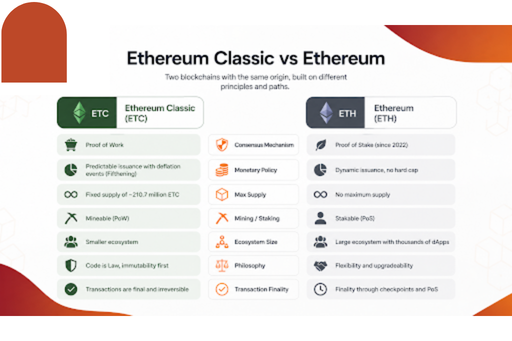
Advantages and Limitations of Ethereum Classic
Ethereum Classic continues to offer several strengths despite operating alongside much larger blockchain networks. One of its biggest advantages is its commitment to immutability: the project maintains that confirmed blockchain transactions should never be reversed, regardless of external events. At the same time, like every cryptocurrency project, it has limitations that users and investors should understand.
| Category | Advantages | Limitations and Risks |
|---|---|---|
| Security Model | A decentralized Proof of Work security model. | Has experienced several 51 percent attacks in its history. |
| Monetary Policy | A predictable maximum token supply. | Subject to cryptocurrency price volatility and evolving regulations. |
| Development | Compatibility with Ethereum Virtual Machine based development. | A much smaller developer ecosystem than Ethereum, resulting in fewer dApps. |
| Network Activity | Lower network activity, which can result in relatively low transaction fees. | Slower ecosystem growth compared to newer Layer 1 blockchains. |
| Market Position | A mature blockchain that has operated since 2016. | Reduced market share due to competition from alternative smart contract platforms. |
These characteristics have allowed Ethereum Classic to maintain an active community even as the broader blockchain industry has become increasingly competitive.
Is Ethereum Classic Still Relevant?
Despite strong competition, Ethereum Classic remains an active blockchain with a dedicated community of developers, miners, exchanges, and long term supporters.
The network continues to process transactions, execute smart contracts, and receive regular software updates. Following Ethereum’s transition to Proof of Stake, some miners moved their computing power to Ethereum Classic, increasing mining participation on the network.
Although Ethereum dominates the smart contract market, Ethereum Classic continues to occupy its own niche by emphasizing decentralization, immutability, and Proof of Work consensus. For users who value these principles, ETC remains a relevant cryptocurrency within the broader digital asset ecosystem.
How to Buy and Store ETC
ETC is widely available through many cryptocurrency exchanges around the world. After purchasing the cryptocurrency, users can store it in wallets that support Ethereum Classic.
Several storage options are available depending on individual security preferences. Software wallets offer convenient access for everyday transactions, while hardware wallets provide additional protection by keeping private keys offline. Some users also choose custodial wallets offered by cryptocurrency exchanges, although these require trusting a third party with asset storage.
Regardless of the storage method, users should protect their recovery phrases, enable two factor authentication where possible, and verify wallet addresses carefully before sending transactions.
Conclusion
Ethereum Classic remains one of the most historically significant blockchain networks in the cryptocurrency industry. As the original Ethereum blockchain, it continues to operate according to the principle that blockchain history should remain permanent and immutable. While Ethereum Classic has a smaller ecosystem than Ethereum, it still supports smart contracts, decentralized applications, and secure peer to peer transactions through its native ETC cryptocurrency.
Today, ETC serves multiple purposes within the blockchain ecosystem, including paying transaction fees, rewarding miners, supporting decentralized applications, and transferring digital value globally. Beyond these traditional blockchain use cases, cryptocurrencies such as ETC are also becoming practical payment methods for digital goods. Platforms like Baxity Store help bridge the gap between cryptocurrency ownership and everyday online spending by allowing users to purchase gift cards, gaming products, prepaid payment solutions, and other digital products with supported cryptocurrencies.
Frequently Asked Questions About Ethereum Classic (ETC)
Can Ethereum Classic support modern decentralized applications?
Yes, Ethereum Classic is still capable of supporting decentralized applications through its compatibility with the Ethereum Virtual Machine (EVM). Developers can build smart contracts using many of the same programming languages and development tools that are available within the broader Ethereum ecosystem. However, the number of active projects on Ethereum Classic is considerably smaller than on Ethereum, which means users have access to a more limited selection of applications. Even so, the network remains suitable for developers who value decentralization, immutability, and a stable blockchain environment. As long as applications are designed with Ethereum Classic’s technical standards in mind, they can operate effectively on the network.
Why do some miners prefer Ethereum Classic?
Ethereum Classic continues to use the Proof of Work consensus mechanism, which allows miners to secure the network using specialized hardware. After Ethereum transitioned to Proof of Stake, many mining operations looked for alternative blockchains that still rewarded computational work. Ethereum Classic became one of the most prominent destinations because of its shared history with Ethereum and compatibility with many existing mining setups. Some miners also appreciate the network’s predictable monetary policy and commitment to maintaining Proof of Work. Although mining profitability changes depending on electricity costs, network difficulty, and ETC market prices, Ethereum Classic remains one of the major mineable cryptocurrencies.
Is Ethereum Classic suitable for long term blockchain development?
Ethereum Classic continues to receive software updates and protocol improvements, making it a viable platform for long term blockchain development. The project is maintained by multiple independent development teams that work on network security, compatibility, and infrastructure improvements. While development progresses at a slower pace than on Ethereum, the network prioritizes stability and backward compatibility over rapid experimentation. Organizations building applications that require an immutable blockchain may find these characteristics attractive. As with any blockchain platform, developers should evaluate ecosystem size, available tools, and long term project goals before selecting Ethereum Classic for production applications.
What factors influence the value of ETC?
Like most cryptocurrencies, the price of ETC is determined by supply and demand in the global market. Investor sentiment, cryptocurrency market trends, macroeconomic conditions, and overall blockchain adoption all influence price movements. Network activity can also affect demand, as higher transaction volumes may increase the need for ETC to pay transaction fees. Exchange listings, institutional interest, regulatory developments, and technological improvements may also contribute to changes in market value. Because cryptocurrency prices can fluctuate significantly over short periods, ETC should be viewed as a high volatility digital asset.
Can Ethereum Classic interact with other blockchain networks?
Ethereum Classic can interact with other blockchain ecosystems through third party bridges, cross chain infrastructure, and interoperability solutions developed by independent projects. These technologies allow digital assets and information to move between compatible networks, although the process often involves additional security considerations. Users should carefully research any bridge or interoperability service before transferring assets, since cross chain protocols have historically been targets for security exploits. Wallet compatibility and supported token standards should also be verified before initiating transfers. As blockchain interoperability continues to evolve, additional solutions may further expand Ethereum Classic’s connectivity with the broader cryptocurrency ecosystem.
What should beginners know before using ETC?
New users should first understand how cryptocurrency wallets, private keys, and blockchain transactions work before acquiring ETC. Since blockchain transfers are generally irreversible, it is important to verify wallet addresses carefully and send a small test transaction when transferring larger amounts. Beginners should also learn how transaction fees work and keep recovery phrases securely stored offline. Choosing a reputable wallet and enabling available security features can significantly reduce the risk of losing access to digital assets. Finally, anyone considering buying ETC should research the project independently and understand both the opportunities and the risks associated with cryptocurrency markets before making financial decisions.