Decentralized finance has changed how people trade digital assets by removing the need for traditional financial intermediaries. Instead of relying on centralized cryptocurrency exchanges to match buyers and sellers, decentralized exchanges allow users to trade directly from their own wallets through blockchain based smart contracts. Among the many decentralized finance protocols available today, Uniswap has become one of the most influential and widely adopted.
Uniswap is a decentralized exchange protocol built primarily on Ethereum that enables users to swap cryptocurrencies without depositing their assets with a centralized platform. Rather than using a traditional order book, it relies on automated liquidity pools and mathematical algorithms to determine prices. Alongside the protocol, the ecosystem includes the UNI governance token, which allows token holders to participate in decisions affecting the future development of the protocol.
This guide explains what Uniswap is, how it works, what makes it different from centralized exchanges, how liquidity pools operate, the role of the UNI token, and the advantages and risks users should understand before interacting with the protocol.
Using Cryptocurrency for Digital Purchases at Baxity Store
Cryptocurrencies have expanded far beyond trading and investing. Today, many people use digital assets as a convenient way to pay for products and services they need online. One of the simplest ways to do this is by purchasing digital products that can be redeemed immediately, allowing cryptocurrency to be used in a practical way without converting it into traditional currency first.
Baxity Store is a digital marketplace designed to make everyday online purchases more accessible through cryptocurrency. Instead of interacting directly with complex blockchain applications or decentralized finance protocols, users can use supported cryptocurrencies to purchase digital products such as gift cards, prepaid payment solutions, gaming credits, and various digital vouchers. After a successful transaction, digital codes are delivered almost instantly, making it easy to activate services or top up accounts within minutes.
In addition to gift cards and gaming products, Baxity Store offers a selection of crypto related cards and vouchers connected to well known digital platforms and payment ecosystems. These products provide a convenient way to convert digital assets into usable balances for subscriptions, online services, entertainment, and other everyday digital purchases. By combining secure cryptocurrency payments with fast digital delivery, Baxity Store helps bridge the gap between digital assets and practical online spending.
What Is Uniswap (UNI)?
Uniswap is an open source decentralized exchange (DEX) protocol that allows users to exchange cryptocurrencies directly through smart contracts. Instead of matching buyers with sellers through an order book, the protocol uses liquidity pools that hold reserves of digital assets. Every trade is executed automatically according to predefined mathematical formulas.
It is important to distinguish between the three main components of the Uniswap ecosystem.
| Component | Description |
|---|---|
| Uniswap Protocol | A collection of smart contracts that execute token swaps and manage liquidity pools. |
| Uniswap Interface | The web application and compatible third party applications that allow users to interact with the protocol. |
| UNI | The governance token that enables community members to vote on proposals affecting the protocol. |
Unlike centralized cryptocurrency exchanges, Uniswap never takes custody of users’ funds. Assets remain in the user’s wallet until a transaction is approved and executed on the blockchain.
Originally launched on Ethereum, Uniswap has expanded to several Ethereum compatible networks, allowing users to access the protocol while choosing networks with different transaction costs and speeds.
Who Created Uniswap and When Was It Launched?
Uniswap was created by software engineer Hayden Adams. Inspired by a concept proposed by Ethereum co founder Vitalik Buterin regarding automated market makers, Adams developed the first version of the protocol during 2018.
The project introduced a new approach to cryptocurrency trading by replacing the traditional order book with liquidity pools governed entirely by smart contracts. This innovation solved one of the largest challenges facing decentralized exchanges at the time, namely the lack of consistent liquidity.
Since its initial launch, the protocol has evolved through several major versions:
- Uniswap v1 introduced the first automated market maker model for Ethereum tokens.
- Uniswap v2 expanded functionality by supporting direct ERC 20 token pairs.
- Uniswap v3 introduced concentrated liquidity, allowing liquidity providers to allocate capital more efficiently.
- Uniswap v4 added a more flexible architecture with programmable hooks that allow developers to customize pool behavior.
In September 2020, the project introduced the UNI governance token. Rather than functioning as the primary currency of the protocol, UNI gives its holders the ability to participate in governance by voting on proposals related to protocol upgrades, treasury management, and ecosystem development.
Today, Uniswap is considered one of the largest decentralized finance protocols and has inspired dozens of similar automated market maker platforms across multiple blockchain ecosystems.
How Does Uniswap Work?
Uniswap replaces the traditional exchange model with smart contracts that automatically process trades between users. There is no central company matching orders or holding customer funds.
Every trade follows a relatively simple process:
- The user connects a compatible cryptocurrency wallet.
- The user selects the token they want to exchange.
- The protocol identifies the most efficient liquidity pool or routing path.
- Smart contracts calculate the exchange rate based on available liquidity.
- The user reviews the estimated output, transaction fees, and price impact.
- After confirming the transaction, the blockchain records the swap and the received tokens appear directly in the user’s wallet.
Because all transactions occur on chain, users must also pay the network fee required by the blockchain they are using. On Ethereum, this fee is paid in ETH, while other supported networks require their own native tokens.
This architecture allows anyone with a compatible wallet to trade supported cryptocurrencies without creating an exchange account or transferring custody of their assets.
What Is an Automated Market Maker?
One of Uniswap’s biggest innovations is the automated market maker, commonly abbreviated as AMM.
Traditional cryptocurrency exchanges rely on order books where buyers submit bids and sellers submit asks. Trades occur only when compatible orders are matched. Uniswap removes this matching process entirely.
Instead, every trading pair is backed by a liquidity pool containing reserves of two different tokens. Smart contracts automatically determine exchange prices by analyzing the balance between these reserves.
When someone purchases one token from the pool, its available supply decreases while the supply of the other token increases. This changes the exchange rate automatically without requiring any human intervention.
This mechanism offers several important benefits:
- Trading remains available even without active buyers and sellers.
- Liquidity is supplied by users rather than a centralized exchange.
- Prices adjust continuously after every transaction.
- Anyone can contribute liquidity and potentially earn a share of trading fees.
The AMM model has become the foundation of many decentralized exchanges that were launched after Uniswap.
What Are Uniswap Liquidity Pools?
Liquidity pools are the foundation of the Uniswap protocol. A liquidity pool is a smart contract that holds reserves of two cryptocurrencies. These reserves allow traders to exchange one asset for another at any time without waiting for another user to take the opposite side of the trade.
Instead of professional market makers supplying liquidity, Uniswap allows ordinary users to contribute assets to these pools. These participants are known as liquidity providers.
For example, a liquidity provider may deposit equal values of ETH and USDC into a liquidity pool. Those assets become available for other users to trade.
In return, liquidity providers receive a portion of the trading fees generated by that pool. The exact return depends on several factors, including trading volume, pool activity, fee tier, and the provider’s share of the total liquidity.
Larger liquidity pools generally provide several advantages:
- Lower price impact for large trades.
- Better exchange rates.
- Reduced slippage.
- More efficient price discovery.
Because liquidity providers expose their assets to changing market prices, providing liquidity also introduces additional risks that users should understand before participating.
How Are Token Prices Determined on Uniswap?
Unlike centralized exchanges, Uniswap does not rely on buyers and sellers negotiating prices through an order book. Instead, prices are determined automatically according to the ratio of assets held inside each liquidity pool.
Whenever someone swaps Token A for Token B, the balance of both assets changes. As a result:
- The available supply of Token A inside the pool increases.
- The available supply of Token B decreases.
- The exchange rate adjusts immediately after the transaction.
Larger trades produce greater changes in the pool balance, which often results in a less favorable exchange rate for the trader. This phenomenon is commonly known as price impact.
Market prices on Uniswap also remain closely aligned with prices on other exchanges because arbitrage traders constantly exploit temporary price differences. Their activity helps restore prices whenever a significant gap appears between Uniswap and the broader cryptocurrency market.
Slippage, Price Impact and Network Fees
Three concepts frequently confuse new users because they all affect the final amount received during a swap.
Slippage refers to the difference between the estimated price shown before confirming a transaction and the actual execution price recorded on the blockchain. Slippage may increase during periods of high market volatility or when liquidity is limited.
Price impact describes how much a specific trade changes the exchange rate inside a liquidity pool. Larger transactions typically create greater price impact because they alter the balance between the assets held in the pool.
Network fees are separate from trading fees. They are paid to blockchain validators for processing transactions and depend on the blockchain being used rather than the Uniswap protocol itself.
Understanding these three factors helps users estimate the true cost of completing a decentralized trade and choose appropriate transaction settings before confirming a swap.
How Do Uniswap Liquidity Providers Earn Money?
Anyone can become a liquidity provider by depositing supported cryptocurrencies into a liquidity pool. In return, the provider receives a position representing their share of that pool.
When other users exchange assets through the pool, they pay trading fees. These fees are distributed among liquidity providers according to their share of the pool and the fee structure of the selected liquidity pool.
Several factors influence the potential return from providing liquidity:
- The amount of liquidity contributed.
- Overall trading volume in the pool.
- The selected fee tier.
- Market volatility.
- The duration that liquidity remains active.
- Changes in the prices of the deposited assets.
Although liquidity providers may earn trading fees, returns are never guaranteed. Market conditions and asset price movements can significantly affect the final result.
What Is Concentrated Liquidity?
Uniswap v3 introduced one of the protocol’s most significant innovations known as concentrated liquidity.
In earlier versions, liquidity providers supplied assets across the entire possible price range, even though much of that capital was rarely used. Concentrated liquidity allows providers to choose a specific price range where they want their funds to be available for trading.
If the market price remains within the selected range, the liquidity is actively used for swaps and earns trading fees. If the price moves outside that range, the position becomes inactive until the market returns.
This approach offers several advantages. Capital can be used more efficiently, liquidity becomes deeper around actively traded prices, and providers may earn higher fee income using less capital than under previous models.
However, concentrated liquidity also requires more active management. Liquidity providers may need to adjust their chosen price ranges as market conditions change.
Uniswap v1, v2, v3 and v4 Explained
Since its launch, Uniswap has introduced several major protocol upgrades, each expanding the capabilities of the decentralized exchange.
- Uniswap v1 demonstrated that automated market makers could successfully replace traditional order books for decentralized trading.
- Uniswap v2 improved routing between ERC 20 tokens, increased trading efficiency, and expanded the protocol’s functionality.
- Uniswap v3 introduced concentrated liquidity, multiple fee tiers, and significantly improved capital efficiency for liquidity providers.
- Uniswap v4 redesigned the protocol architecture by introducing hooks, customizable smart contract extensions that allow developers to create more flexible liquidity pools with specialized behavior.
Rather than replacing earlier innovations, each version built upon the previous one while improving efficiency, flexibility, and developer capabilities.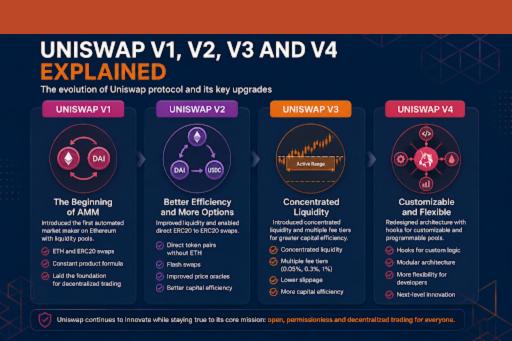
What Are Uniswap v4 Hooks?
Hooks are one of the defining features introduced with Uniswap v4. A hook is an optional smart contract that can execute custom logic before or after specific pool actions such as swaps, liquidity additions, or liquidity withdrawals.
This architecture allows developers to build customized liquidity pools with features that were previously impossible without modifying the core protocol.
Potential applications include:
- Dynamic trading fees that adjust automatically based on market conditions.
- Automated liquidity management strategies.
- Customized reward mechanisms.
- Additional security controls.
- Specialized trading rules for individual pools.
Because hooks can be developed by different teams, users should carefully evaluate any custom implementation before interacting with a pool that relies on third party code.
What Is the UNI Token?
UNI is the governance token of the Uniswap ecosystem. Unlike cryptocurrencies that are primarily designed for payments, UNI gives holders the ability to participate in decentralized governance. Token holders can vote on proposals affecting protocol development, treasury allocations, ecosystem grants, and other governance decisions.
UNI is an ERC 20 token that operates on Ethereum and can also be available through supported networks and infrastructure compatible with the Uniswap ecosystem.
It is important to understand that UNI is not required for normal token swaps. Anyone can exchange supported cryptocurrencies through Uniswap without owning UNI, provided they have sufficient funds to pay the required network transaction fees.
What Is UNI Used For?
The primary purpose of UNI is decentralized governance. Token holders can participate in the ongoing development of the protocol by proposing ideas, discussing improvements, and voting on governance proposals.
Common uses of UNI include:
- Voting on protocol upgrades.
- Participating in treasury governance.
- Delegating voting power to other community members.
- Supporting ecosystem funding proposals.
- Holding the token as part of a diversified cryptocurrency portfolio.
Some decentralized finance applications also accept UNI as collateral or integrate it into additional financial services, although these use cases depend on individual third party platforms rather than the Uniswap protocol itself.
How Does Uniswap Governance Work?
Uniswap is governed by its community rather than by a single company. Governance generally follows a structured process. Community members first discuss new ideas, after which formal proposals can be prepared for voting. Eligible UNI holders or their delegates then vote on whether proposed changes should be adopted.
Approved proposals may influence areas such as:
- Protocol upgrades.
- Treasury spending.
- Ecosystem grants.
- Governance parameters.
- Long term development priorities.
This governance model allows the protocol to evolve through community participation while maintaining transparency throughout the decision making process.
What Can Uniswap Be Used For?
Although Uniswap is best known as a decentralized exchange, its functionality extends well beyond simple cryptocurrency swaps. Users can utilize the protocol for a variety of activities, including:
- Exchanging supported cryptocurrencies directly from a self custodial wallet.
- Accessing newly launched ERC 20 tokens.
- Providing liquidity to trading pools.
- Earning a share of trading fees as liquidity providers.
- Participating in decentralized governance through UNI.
- Integrating token swaps into decentralized applications.
- Developing new decentralized financial products using the open source protocol.
Its permissionless design has made Uniswap one of the core infrastructure layers supporting the broader decentralized finance ecosystem.
Advantages and Risks of Uniswap
Uniswap offers several benefits compared with many traditional cryptocurrency exchanges. Users maintain control of their own assets throughout the trading process because funds remain in their wallets until transactions are executed. At the same time, despite its popularity, Uniswap also presents several important risks that users should understand before participating.
| Category | Advantages | Risks and Limitations |
|---|---|---|
| Custody | Users maintain control of their own assets throughout the trading process. | Confirmed transactions generally cannot be reversed once executed on chain. |
| Transparency | The protocol is open source, allowing anyone to inspect the smart contracts. | Fake or fraudulent tokens can be listed without approval from a central authority. |
| Access | Anyone can create liquidity pools or trade supported tokens without approval. | Smart contract vulnerabilities in third party applications remain a risk. |
| Network Flexibility | Support for multiple blockchain networks gives users more flexibility on cost and speed. | Network fees can rise significantly during periods of congestion. |
| Liquidity Provision | Liquidity providers can generate fee income by supplying assets to trading pools. | Price volatility, slippage, and impermanent loss can all affect returns. |
Understanding these risks is essential before using any decentralized finance protocol.
What Is Impermanent Loss?
Impermanent loss is one of the most important concepts for liquidity providers to understand. It occurs when the relative prices of the two assets deposited into a liquidity pool change after the deposit is made.
As traders continuously rebalance the pool, the provider may end up holding a different proportion of each asset than they originally contributed. When compared with simply holding both assets outside the pool, the overall value of the liquidity position may become lower.
The term “impermanent” refers to the fact that this difference may decrease if prices later return to their previous relationship. However, if liquidity is withdrawn while the price difference remains, the loss becomes permanent.
Trading fees earned while providing liquidity may partially or fully offset this difference, but they do not eliminate the underlying risk.
Uniswap vs. Centralized Exchanges
Both decentralized and centralized exchanges allow users to trade cryptocurrencies, but they operate in fundamentally different ways.
Centralized exchanges manage customer accounts, hold user assets, and process trades through internal systems. Uniswap uses smart contracts to execute trades directly on the blockchain while users retain control of their private keys throughout the process.
As a result, decentralized exchanges typically offer greater transparency and self custody, while centralized exchanges often provide customer support, fiat currency services, and additional trading tools. The better choice depends on a user’s priorities, technical experience, and preferred trading methods.
Uniswap vs. PancakeSwap
Uniswap and PancakeSwap are both decentralized exchanges based on automated market maker technology. Both allow users to swap cryptocurrencies, provide liquidity, and participate in decentralized finance applications.
The primary differences involve their ecosystem focus, supported blockchain networks, governance tokens, fee structures, and available decentralized finance services. Although both protocols have expanded beyond their original networks, each continues to maintain its own ecosystem, community, governance process, and development roadmap.
How to Use Uniswap
Using Uniswap typically involves a straightforward sequence of steps.
- Install a compatible cryptocurrency wallet.
- Add funds to the wallet, including the native token needed for network fees.
- Connect the wallet to the Uniswap interface.
- Select the tokens to exchange.
- Review the quoted exchange rate, estimated output, and transaction costs.
- Confirm the transaction through the wallet.
- Wait for blockchain confirmation before the new assets appear in the wallet.
Before approving any transaction, users should verify the token contract address, confirm that they are connected to the intended blockchain network, and carefully review all transaction details.
How to Buy and Store UNI
UNI can be acquired through centralized cryptocurrency exchanges, decentralized exchanges, or compatible wallet applications that support token swaps.
Once purchased, UNI can be stored in self custodial wallets that support ERC 20 tokens or other supported blockchain environments where the token is available.
As with any cryptocurrency, users should securely back up their recovery phrase, protect private keys, and verify network compatibility before transferring tokens between wallets.
Is UNI a Good Investment?
Whether UNI represents a suitable investment depends on an individual’s financial goals, investment strategy, and tolerance for risk. Like most cryptocurrencies, UNI can experience significant price fluctuations over relatively short periods.
Several factors may influence its long term value, including protocol adoption, governance participation, competition among decentralized exchanges, overall cryptocurrency market conditions, regulatory developments, and continued innovation within the Uniswap ecosystem.
It is also important to distinguish between using the Uniswap protocol and investing in the UNI token. Many users interact with Uniswap regularly without ever owning UNI.
The Future of Uniswap
Uniswap continues to evolve alongside the broader decentralized finance ecosystem. Future development is expected to focus on expanding support for additional blockchain networks, improving trading efficiency, increasing developer flexibility through hooks, strengthening governance participation, and enhancing liquidity management tools.
As decentralized finance continues to mature, Uniswap is likely to remain an important piece of blockchain infrastructure. However, its future growth will depend on continued innovation, community participation, regulatory developments, and competition from other decentralized exchange protocols.
Conclusion
Uniswap has fundamentally changed how decentralized cryptocurrency trading works by replacing traditional order books with automated liquidity pools powered by smart contracts. This innovation has made peer to peer token exchanges more accessible while allowing users to retain control of their own assets throughout the trading process.
The UNI token serves an important governance role within the ecosystem, while liquidity providers help maintain the markets that power the protocol. Features such as concentrated liquidity, multi network support, and the flexible architecture introduced with Uniswap v4 have allowed the protocol to remain one of the leading decentralized exchanges in the cryptocurrency industry.
Although Uniswap offers transparency, self custody, and open access, users should also understand the associated risks, including price volatility, slippage, network fees, and impermanent loss. Learning how these mechanisms work can help users make more informed decisions when interacting with decentralized finance applications.
Frequently Asked Questions About Uniswap (UNI)
Can I Lose Funds Even If Uniswap Itself Continues to Work Normally?
Yes, it is possible to lose funds even when the Uniswap protocol is operating exactly as intended. Most losses occur because users interact with fake tokens, approve malicious smart contracts, send assets to the wrong network, or misunderstand how decentralized transactions work. Unlike traditional financial platforms, blockchain transactions generally cannot be canceled after confirmation. For this reason, it is essential to verify token contract addresses, review transaction details carefully, and use trusted wallet software. Spending a few extra minutes checking information before confirming a transaction can significantly reduce the risk of costly mistakes.
Why Do Some Tokens Have Different Prices on Uniswap Than on Other Exchanges?
Temporary price differences between Uniswap and centralized exchanges are a normal part of cryptocurrency markets. Prices on decentralized exchanges depend on the balance of assets inside individual liquidity pools, while centralized exchanges determine prices through their order books. Large trades or sudden market movements can briefly create differences between platforms. Professional traders known as arbitrageurs usually identify these gaps and execute trades that bring prices closer together. As a result, noticeable price differences often disappear quickly, especially for cryptocurrencies with high trading volume and deep liquidity.
Can Anyone Create a Token and List It on Uniswap?
Yes. One of the defining features of Uniswap is that anyone can create a compatible token and establish a liquidity pool without requesting approval from a central authority. This open access encourages innovation and allows new blockchain projects to become available quickly. At the same time, it also means that fraudulent or imitation tokens may appear alongside legitimate ones. Users should never rely only on a token’s name or logo when making a purchase. Checking the official contract address through the project’s website or other trusted sources is one of the safest practices before completing any transaction.
Why Do Network Fees Change So Much?
Network fees are determined by the blockchain rather than by Uniswap itself. When many users submit transactions at the same time, validators prioritize transactions that include higher fees, causing average costs to increase. During periods of lower activity, transaction fees often become much lower because there is less competition for block space. Fees also vary significantly between different blockchain networks supported by the Uniswap ecosystem. Users who are not in a hurry sometimes wait for quieter periods before submitting transactions in order to reduce costs.
Can Businesses and Developers Build Services Using Uniswap?
Yes. Because Uniswap is open source, developers can integrate its liquidity and trading functionality into wallets, decentralized applications, portfolio management tools, payment platforms, and many other blockchain services. Instead of creating their own exchange infrastructure, developers can interact with the protocol through publicly available smart contracts and software development tools. This approach has helped establish Uniswap as one of the core building blocks of the decentralized finance ecosystem. Many blockchain applications that appear unrelated to Uniswap still rely on its liquidity in the background to process token swaps efficiently.
What Should Beginners Learn Before Using Uniswap for the First Time?
New users should first become comfortable with the basics of self custodial cryptocurrency wallets and blockchain transactions. Understanding private keys, recovery phrases, wallet security, network selection, and transaction confirmation is just as important as learning how token swaps work. Beginners should also practice identifying official websites and verifying token contract addresses to reduce the risk of scams. Starting with a small transaction can provide valuable experience before transferring larger amounts. Building this foundation makes it much easier to use decentralized finance applications safely and confidently.